What Is CDP: Understanding the World’s Most Influential Environmental Scoring System
CDP is the world’s leading environmental disclosure system, helping organisations measure, score, and manage climate, water, and forest impacts.


.svg)
Table of Contents


In sustainability today, silence is no longer an option. Stakeholders no longer take vague commitments at face value, they expect proof. And proof begins with disclosure.
That’s where CDP (Carbon Disclosure Project) comes in.
CDP is a global non-profit that runs the world’s leading environmental disclosure system, helping companies, cities, and investors manage their environmental impacts. Each year, over 23,000 organisations report through CDP on their climate strategies, water use, and forest impacts.
Think of CDP as the climate world’s report card: it doesn’t just measure how much you emit, but how prepared you are to handle the future.
From Data to Direction: The Evolution of CDP
CDP began in 2000 with a radical idea that markets would reward companies that disclose environmental data and penalise those that don’t. Back then, sustainability reporting was optional. Today, it defines corporate credibility.
Since its first batch of questionnaires sent to 500 global corporations, CDP has expanded across 90 countries, integrating climate, water, and deforestation disclosures into one comprehensive platform. Its frameworks are now aligned with leading sustainability standards, including TCFD, ISSB, and the EU’s CSRD.
Over time, CDP has evolved from being a data collection platform to a global benchmark of environmental leadership. Businesses no longer disclose simply because they have to, they do it because CDP scores directly influence investor trust, brand reputation, and access to sustainable finance.
Inside CDP Scores: What They Really Measure
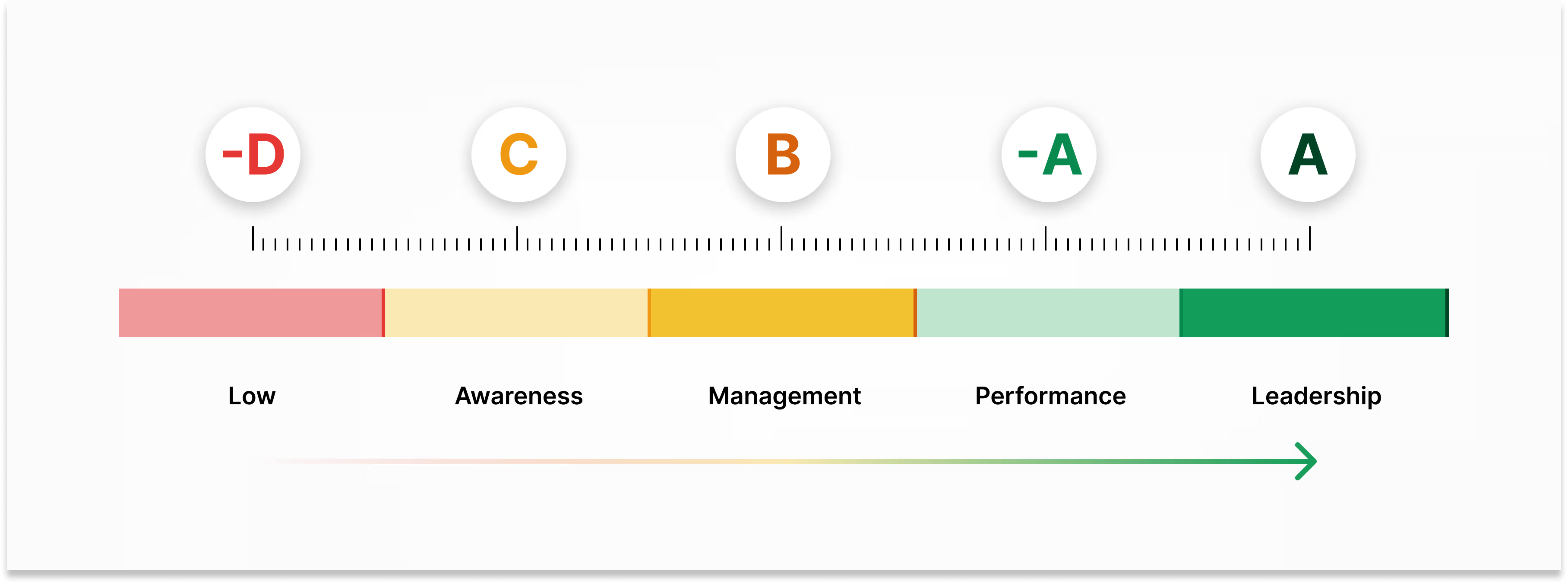
Every year, CDP hands out its own version of a report card, but this one grades the planet’s biggest players. Scores range from D- to A, revealing not who studied hardest, but who’s genuinely walking the talk on climate action. It’s more than a mark on paper; it’s a measure of maturity, showing how deeply sustainability runs through a company’s decisions and long-term strategy.
CDP evaluates organisations across three key thematic areas:
{{blurb}}
Each theme is scored through four performance bands that build upon one another:
- Disclosure (D-/D): Basic transparency. The company reports its data but may lack comprehensive strategies or reduction plans.
- Awareness (C-/C): The company recognises its environmental risks and begins to analyse their business impact.
- Management (B-/B): Concrete policies and actions are in place to manage risks and reduce emissions.
- Leadership (A-/A): The company demonstrates best practice, verified progress, and ambitious science-based targets aligned with global frameworks.
At the highest level, CDP scores serve as the bridge between commitment and credibility.
Why CDP Scores Matter
Think of CDP scores as a credibility test in a world where everyone claims to be green. They separate intent from impact, showing which companies are truly transforming and which are just talking.
For investors, CDP scores act as a due diligence shortcut. Research shows that companies with higher CDP ratings consistently attract more sustainable investment and demonstrate stronger long-term resilience. Firms like BlackRock and HSBC Asset Management have integrated CDP disclosures into their ESG evaluation models to gauge how exposed a company is to climate risk.
For regulators, CDP alignment shows readiness. With frameworks such as the EU Corporate Sustainability Reporting Directive (CSRD) and the UK’s Streamlined Energy and Carbon Reporting (SECR) tightening disclosure norms, companies reporting through CDP are already ahead of the compliance curve.
For customers and partners, CDP scores build trust. A strong score becomes proof that a business is not only transparent but forward-thinking, one that’s preparing for a low-carbon future rather than reacting to it.
The CDP score, in essence, reflects more than environmental performance, it reflects leadership. Companies that perform well here are not just reducing emissions; they are earning credibility, safeguarding reputation, and positioning themselves as responsible players in a climate-conscious economy.
Challenges in Achieving High CDP Scores
Getting a high CDP score isn’t just about bold climate promises. It’s like sitting an open-book exam where every claim needs proof, and there’s nowhere to hide when the data doesn’t add up.
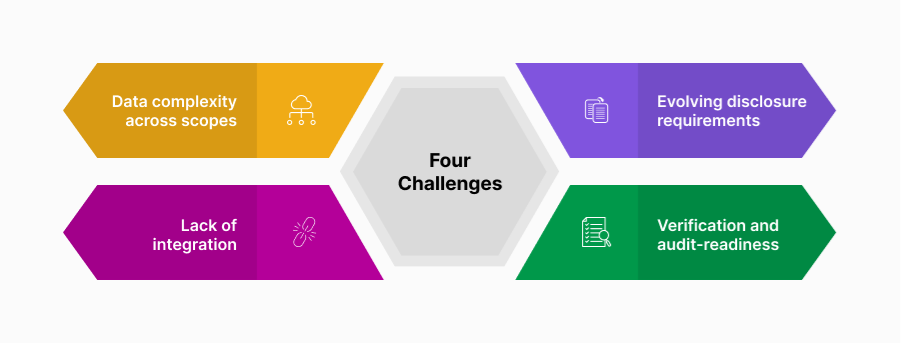
Data complexity across scopes
For many organisations, the biggest hurdle lies in managing Scope 3 emissions. These are indirect emissions that occur across the value chain, suppliers, logistics, product use, and waste. Since they often account for more than 70% of a company’s total footprint, incomplete data here can drag down CDP scores significantly.
Evolving disclosure requirements
The CDP questionnaire changes every year to align with global frameworks such as the Task Force on Climate-related Financial Disclosures (TCFD) and Science Based Targets initiative (SBTi). Companies often struggle to keep pace, especially when reporting standards differ across regions.
Lack of integration
Many businesses still treat sustainability as an annual exercise rather than an integrated part of corporate strategy. Without linking carbon management to financial performance, risk assessment, or procurement decisions, even well-intentioned companies fall short of CDP’s leadership criteria.
Verification and audit-readiness
CDP places strong emphasis on data verification. Unsupported claims or inconsistent calculations can lower scores quickly. Ensuring that emissions data is traceable, auditable, and aligned with the GHG Protocol requires both expertise and reliable tools.
This is where KarbonWise steps in. Our platform simplifies complex Scope 3 tracking, aligns disclosures with CDP, CSRD, and SECR requirements, and ensures that your data is verified and audit-ready. From automated data collection to performance analytics, KarbonWise turns sustainability reporting into a competitive advantage.
The Way Forward
True climate leadership begins with measurement, but it thrives through accountability and evolution. As disclosure frameworks like CDP continue to shape corporate climate strategy, the focus is shifting from what companies report to how they act on it. Future advancements in sustainability tech will make climate reporting sharper, faster, and more comparable across industries.
Tools like KarbonWise are built for this next phase, where audit-ready data becomes the cornerstone of corporate credibility. In a world racing towards net-zero, the companies that master transparency today will define the sustainable economy of tomorrow.
{{cta}}
{{accordion}}
{{sources}}
.avif)
.avif)
.avif)

Continue Reading
The EU Just Cut CSRD Reporting Requirements by 60%. Here Is What Actually Changed.
The EU has significantly changed CSRD reporting requirements. Explore the revised ESRS, what changed, who remains in scope, and what businesses need to do next.

SBTi FLAG Guidance v1.2: What Changed and What to Do Next
Learn what's new in SBTi FLAG Guidance v1.2, including updated deadlines, mandatory commodities, no-deforestation requirements, and practical steps for businesses.
How to conduct a double materiality assessment: A practical step-by-step guide (2026)
Learn how to conduct a Double Materiality Assessment with this practical step-by-step guide covering impact and financial materiality, IROs, stakeholder engagement, scoring, materiality matrices, and ESG reporting.


.avif)








.svg)
.svg)