UAE Climate Law: A New Framework for Accountability and Low-Carbon Growth
The UAE Climate Law introduces mandatory emissions measurement, reporting and accountability for organisations operating in the UAE.


.svg)
Table of Contents


Picture a team reviewing this year’s sustainability priorities. Someone mentions the UAE Climate Law, and suddenly the tone of the meeting changes. Until recently, climate action plans were often treated as directional. Now, with the UAE’s federal climate legislation in force, organisations understand that climate responsibility is becoming structured, measurable and directly tied to operating conditions. The UAE Climate Law introduces a clearer framework: businesses are required to measure and report emissions consistently, and to demonstrate progress in line with applicable national targets and sector-specific guidance. For many, this is the first moment where climate intent becomes a legal obligation rather than a strategic preference.
The law supports the UAE’s wider national goals, including its commitment to net zero and its role as a regional leader in climate governance. Far from being an abstract regulatory shift, it signals the beginning of a decade where transparent environmental performance will influence competitiveness, reputation and business continuity. Companies that adapt early will find the transition smoother. Those that delay may face compliance risk and costly last-minute adjustments.
Why the UAE Climate Law Matters Now
One of the strongest signals about the law’s relevance is that the UAE has legally formalised climate responsibilities under Federal Decree-Law No. 11 of 2024, setting clear expectations for emissions measurement, reduction and reporting.
This foundation ensures that climate action is no longer optional. Instead, organisations must begin documenting their environmental performance in ways regulators, investors and customers can verify.
Recent analysis aimed at business audiences highlights that the law introduces mandatory emissions measurement, clear compliance timelines and structured expectations around reporting, which tighten the link between climate performance and operating norms.
These developments reflect the UAE’s transition from ambition to implementation. Companies are now expected to move beyond general sustainability commitments to practical, data-backed climate planning.
Compliance Timelines and Consequences
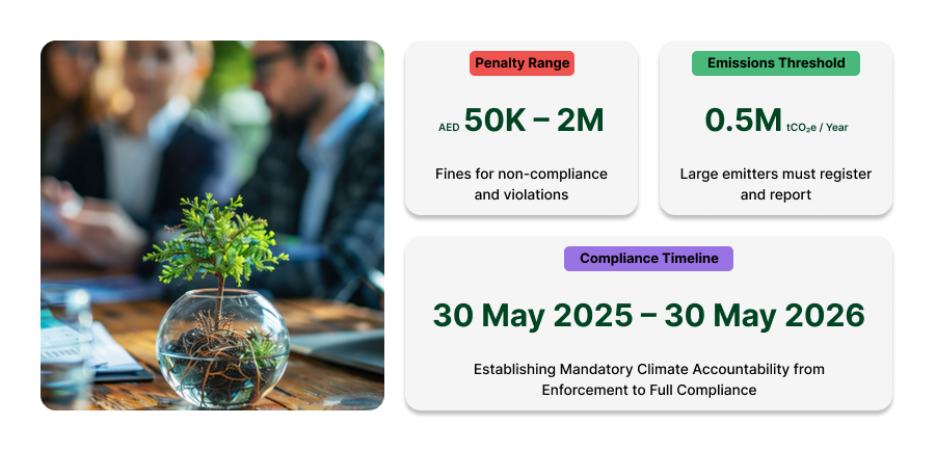
Understanding timelines is essential for effective planning. While the law came into force on 30 May 2025, businesses are required to demonstrate compliance by 30 May 2026. Penalties may range from AED 50,000 to AED 2 million, depending on the nature of the violation, enforcement assessment, and applicable provisions of the law. These numbers highlight that climate oversight is now a regulated responsibility, not an aspirational programme.
The clarity of these deadlines also helps organisations structure multi-year plans. Many will need to strengthen internal data systems, refresh supplier engagement processes and align governance models with the law’s requirements. Early movers stand to benefit from less disruption and greater investor confidence.
How the Law Connects to National Climate Goals
The UAE’s climate framework sits within a broader national strategy. The UAE has committed to reducing emissions by about 20 percent by 2030, a target confirmed by the Ministry of Climate Change and Environment. This figure offers organisations a clear directional benchmark for their own transition plans and shows the scale of transformation underlying the federal law.
This target matters because it gives organisations a measurable reference point for carbon reduction pathways. While sectors will face different expectations, having a national anchor helps unify planning and simplify internal decision-making.
Climate analysis also points to the global context. Pathway models for the UAE show that significant changes in the energy mix and emissions trajectory are needed to align with international climate goals, reinforcing why structured national legislation is essential. These models guide organisations in understanding the scale of long-term change.
Together, these insights demonstrate that the UAE Climate Law is part of a larger policy ecosystem designed to support resilience, investment confidence and national competitiveness.
What the Law Means for Organisations
For businesses, the law has four major implications:
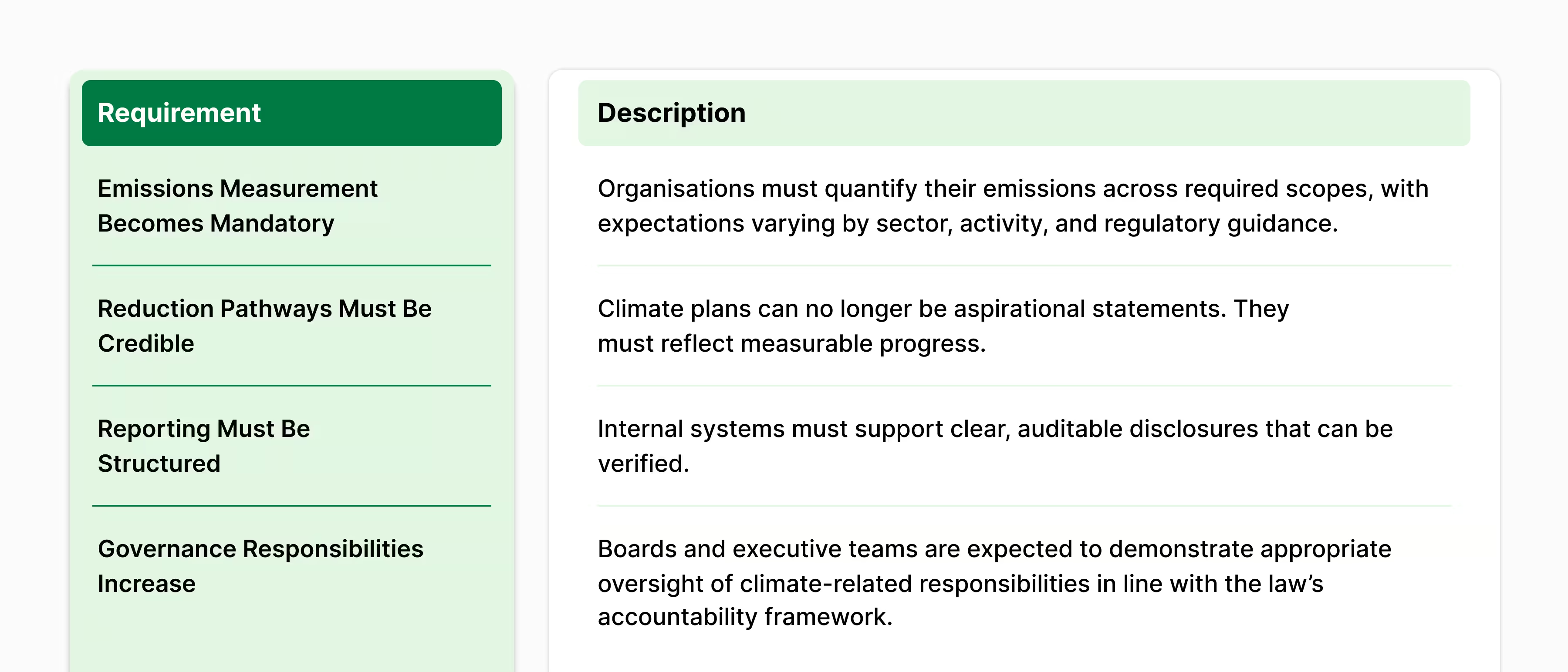
These expectations will reshape operational planning, supplier engagement and investment decisions across industries.
Core Components of Climate Readiness
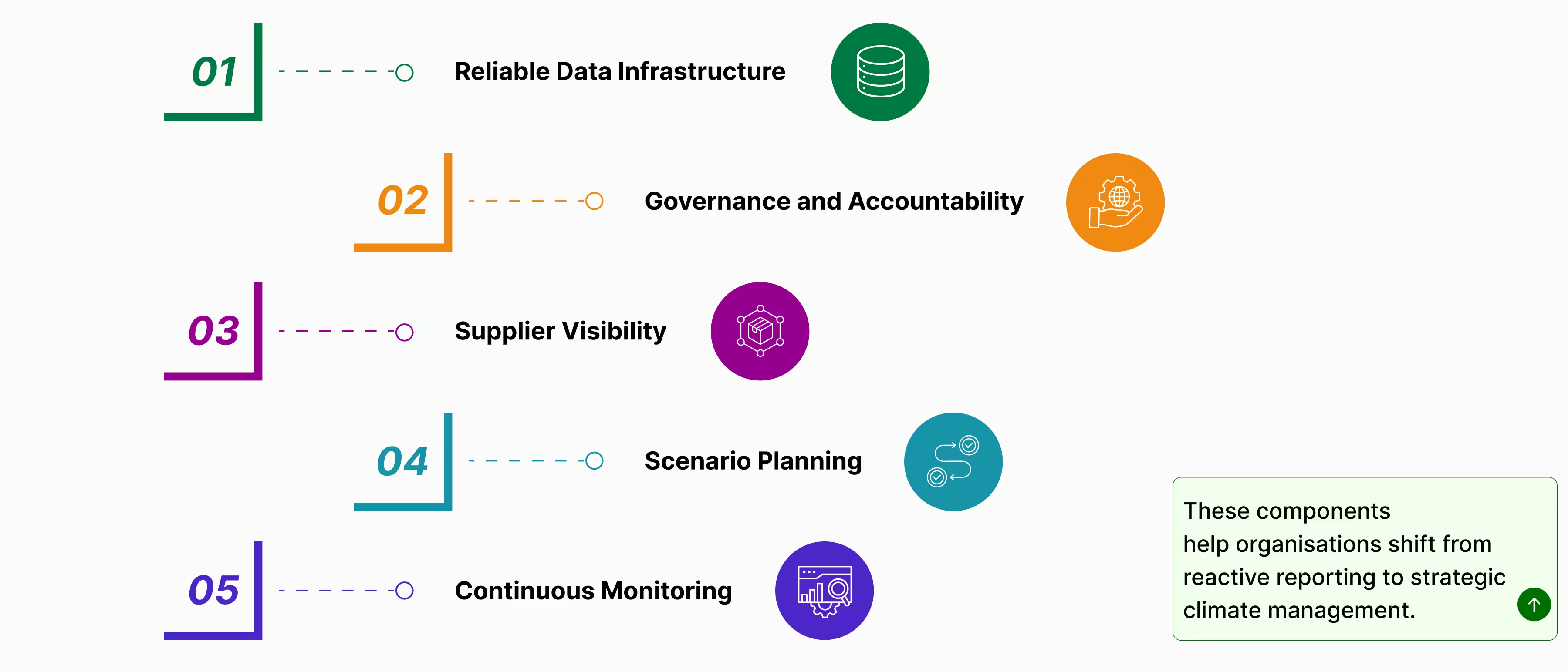
- Reliable Data Infrastructure
Businesses need systems that can collect, validate and store emissions data in repeatable ways.
- Governance and Accountability
Clear roles and responsibilities support better oversight and performance tracking.
- Supplier Visibility
Upstream emissions must be understood to improve accuracy and reduce risk.
- Scenario Planning
Organisations benefit from exploring future regulatory, market and climate conditions.
- Continuous Monitoring
Progress reviews help ensure reduction pathways stay on track.
Foundations That Strengthen Climate Implementation
{{flipcards}}
Case Studies: Climate Action in Practice
Energy Sector: ADNOC and emissions data systems
Abu Dhabi National Oil Company has publicly outlined its investments in emissions monitoring, methane management and digital energy systems as part of its wider decarbonisation strategy. The organisation has emphasised the role of consistent emissions data in supporting operational efficiency, regulatory reporting and long-term transition planning. This reflects how large emitters in the energy sector are strengthening internal data infrastructure to meet increasing climate accountability expectations.
Retail and Real Estate: Majid Al Futtaim and supplier engagement
Majid Al Futtaim has integrated supplier sustainability requirements across its retail and real estate portfolio, including data collection related to energy use and emissions. Through structured engagement with tenants and suppliers, the group has improved visibility into upstream impacts, illustrating how supply chain collaboration supports more accurate reporting and risk management under emerging climate regulations.
Manufacturing and Aviation: Emirates Group and long-term planning
Emirates Group has linked climate considerations to long-term capital planning, including fuel efficiency, sustainable aviation fuel trials and operational optimisation. By aligning investment decisions with expected emissions trajectories, the group demonstrates how scenario planning and governance integration can support resilience as climate regulation tightens across sectors.
How the Climate Law Supports Business Resilience
Regulation is only one side of the story. The law also strengthens business confidence by standardising expectations across sectors. Organisations with clear climate plans often see improved investor trust, stronger customer relationships and lower operational uncertainty.
The law encourages transparency, and transparency builds credibility. When organisations report emissions in structured ways, they position themselves for smoother interactions with regulators, lenders and partners. The clarity of the legislative framework also helps businesses forecast future commitments more accurately.
Where KarbonWise Helps
KarbonWise supports climate-readiness by bringing emissions, supplier and operational information into a single, consistent system. It helps organisations monitor and analyse emissions across relevant scopes, link climate data with internal decision-making, and align disclosures with multiple reporting frameworks. The platform also supports supplier engagement and data validation, helping teams move away from fragmented spreadsheets towards structured, audit-ready processes. This makes it easier to respond to the UAE Climate Law’s expectations with confidence and clarity.
{{cta}}
{{accordion}}
{{sources}}

%20(2).avif)
%20(2).avif)
%20(2).avif)
Continue Reading

The EU Just Cut CSRD Reporting Requirements by 60%. Here Is What Actually Changed.
The EU has significantly changed CSRD reporting requirements. Explore the revised ESRS, what changed, who remains in scope, and what businesses need to do next.

SBTi FLAG Guidance v1.2: What Changed and What to Do Next
Learn what's new in SBTi FLAG Guidance v1.2, including updated deadlines, mandatory commodities, no-deforestation requirements, and practical steps for businesses.

How to conduct a double materiality assessment: A practical step-by-step guide (2026)
Learn how to conduct a Double Materiality Assessment with this practical step-by-step guide covering impact and financial materiality, IROs, stakeholder engagement, scoring, materiality matrices, and ESG reporting.


.avif)









.svg)
.svg)