CBAM in 2026: The Cost Is Small Today. Here Is Exactly How It Compounds
CBAM costs may seem small today, but they increase significantly over time. Discover how the phase-in schedule, default values, and compliance obligations affect exporters through 2034.

.svg)
Table of Contents


The EU's Carbon Border Adjustment Mechanism has been live since January 2026, and the first certificate price has been published. But the number most exporters are managing right now - a few euros per tonne - is roughly one-fortieth of what it becomes by 2034. In 2026, only 2.5% of embedded emissions are priced. By 2034 that rises to 100%. The compliance infrastructure required to meet that obligation today is identical to what will be required when the full cost lands. That is the gap worth acting on now, not later.
Our earlier blogs on CBAM compliance for Indian exporters and why emissions data decides EU market access covered the fundamentals: what CBAM is, how verification works, the three-step readiness roadmap, and which Indian sectors face the highest exposure. This piece covers what has moved significantly since those pieces were published and that most businesses in CBAM-exposed sectors have not yet acted on.
The De Minimis Threshold: Who is Actually Exempt?
CBAM includes a de minimis exemption, but the older compliance strategy that relied on a €150 consignment value is now obsolete. The EU has officially replaced financial boundaries with a strict mass-based threshold.
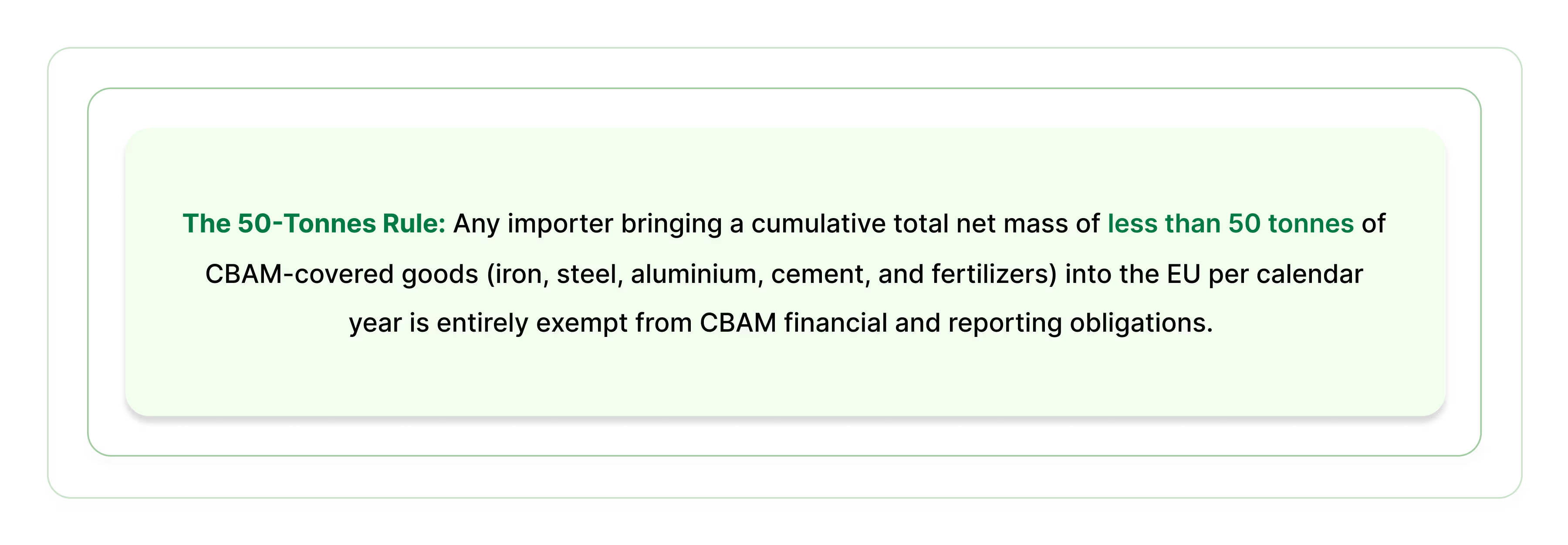
Two critical catch clauses: first, this exemption does not apply to electricity or hydrogen, which face immediate compliance regardless of volume. Second, this is an all-or-nothing cliff. If your business imports 49.9 tonnes, you owe nothing. If a final shipment pushes your annual total to 50.1 tonnes, your entire volume for that year retroactively becomes subject to CBAM compliance and certificate liabilities. For businesses currently importing at volumes close to the threshold, tracking cumulative net mass by calendar year is now a live compliance task, not an operational footnote.
The Phase-In Schedule: The Full Cost Ramp, Confirmed
CBAM does not apply at full cost from day one. It phases in gradually, mirroring the year-by-year withdrawal of free allowances that EU domestic producers receive under the EU Emissions Trading System. The percentage of embedded emissions priced in any given year is called the CBAM phase-in factor, and the full confirmed schedule, set out in Implementing Regulation (EU) 2025/2620 and the original Regulation (EU) 2023/956, runs as follows:
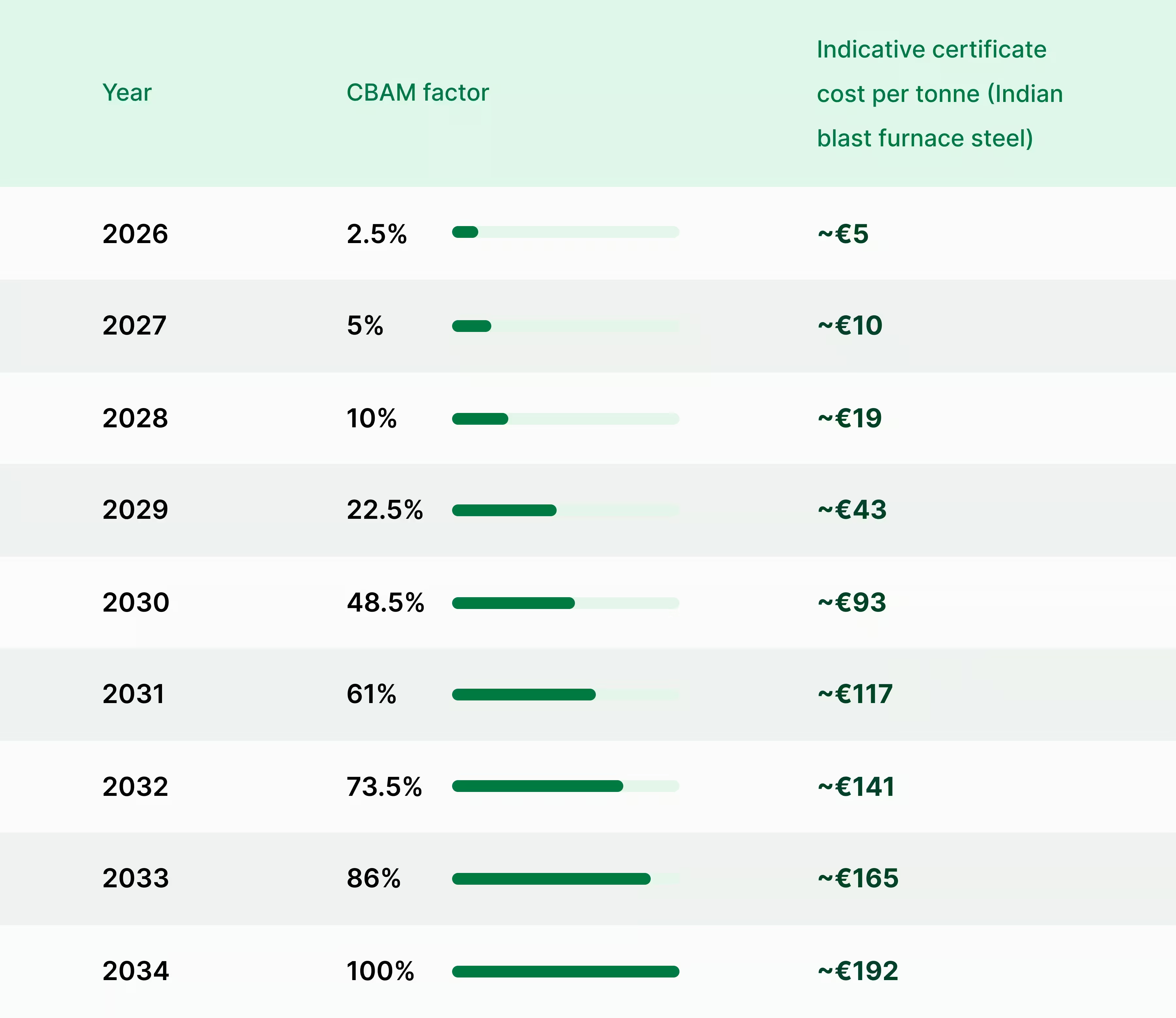
Indicative estimates based on Indian sector average emission intensity of 2.55 tCO₂/tcs (IEEFA) and Q1 2026 certificate price of €75.36/tCO₂e. Actual costs vary by facility, production route, and prevailing EU ETS price.
The cost in 2026 is modest. The cost in 2030 is a material P&L item. The cost in 2034 is equivalent in magnitude to the tariff shocks currently reshaping global metals trade. Early market signals already reflect this: Indian steel exports to the EU fell during the transitional reporting phase, and aluminium shipments softened as EU buyers sought discounts and firmer emissions data - before full financial obligations had even begun. What makes this schedule strategically important is that the compliance infrastructure required at 2.5% is identical to what is required at 100%. Building it now, at low financial exposure, allows time for mistakes and corrections. Building it under financial pressure in 2030 does not.
The First Published Certificate Price: €75.36 per Tonne
On 7 April 2026, the European Commission published the first official CBAM certificate price: €75.36 per tonne of CO₂e, calculated as the volume-weighted average of EU ETS auction clearing prices for Q1 2026. This is the legally binding price applying to all CBAM-eligible goods imported into the EU between January and March 2026. When certificates go on sale from 1 February 2027, Q1 2026 importers will purchase at this rate.
EU ETS prices were volatile through the quarter - they peaked above €92 per tonne in mid-January before falling to the low €60s per tonne in mid-March on policy uncertainty ahead of ETS reform discussions - which means the €75.36 quarterly average came in lower than some importers had anticipated. For exporters pricing multi-year supply contracts into the EU, this volatility is the harder problem. The Q2 price expected July 2026 could look materially different, and from 2027 the Commission moves to weekly publication, making forward pricing significantly more complex.
Certificate Management from 2027: The 50% Quarterly Rule
While the definitive phase operates on an annual cycle - culminating in the final declaration and certificate surrender deadline on 30 September 2027 for the 2026 reporting year - businesses cannot afford to treat this as a single, year-end payment. In practice this means CBAM is not a year-end settlement. It is a quarterly cash-flow obligation from the moment certificate sales open.
The 50% Rule (Effective February 1, 2027): Once the central purchasing platform goes live in early 2027, authorized declarants must maintain a rolling quarterly cushion. By the end of each calendar quarter, your CBAM registry account must hold certificates representing at least 50% of the total embedded emissions imported since the start of that calendar year. The EU allows this buffer to be estimated using default values however this does not waive the default value markup on the final annual declaration. Failing to maintain this 50% buffer at the end of any given quarter will constitute an independent, sanctionable compliance violation - even if you manage to purchase and surrender the full 100% by the annual September deadline.
A practical illustration: a product with embedded direct emissions of 2.0 tCO₂ per tonne produces a 2026 CBAM liability of roughly
2.0 × €75.36 × 2.5% = approximately €3.77 per tonne of product
(Before any deduction for a verified carbon price already paid in the country of origin).
The same calculation at the 2030 phase-in factor of 48.5% produces approximately €73 per tonne. These are not projected figures - they are the same formula applied to the same certificate price as the factor changes each year.
Direct vs Indirect Emissions: The Sector Split That Changes Your Liability
Your sector determines what you owe - and the gap between sectors is wider than most compliance teams expect.
Sectors where only direct emissions (Scope 1) are priced: iron and steel, aluminium, hydrogen. Electricity consumed in production must be monitored and reported but does not yet trigger financial liability for these sectors.
Sectors where both direct and indirect emissions (Scope 1 plus Scope 2) are priced:
cement, fertilisers, electricity. A fertiliser plant running on a coal-heavy grid will face a substantially higher total CBAM cost than a plant with identical direct process emissions running on renewable electricity - and that difference is already in scope, not pending some future rule change.
The aluminium sector should track this closely. Indirect emissions from electricity account for as much as 60% of aluminium's total carbon footprint, and current CBAM rules exclude them entirely - a temporary advantage for producers running on carbon-intensive grids, since the cost of dirty power isn't yet priced into their CBAM liability. The EU has signalled intent to revisit this in future legislative cycles. On 13 May 2026 the Commission opened a four-week consultation on exactly this question: how to set default factors for indirect emissions, when declarants can use actual data instead, and whether indirect coverage should extend to more sectors. A technical study on indirect emissions, tied to that consultation, closed for comment on 10 June 2026 and will feed into the Commission's broader 2027 review of CBAM's scope - but the direction of travel for aluminium producers is now harder to ignore
The Default Value Question: Your Choice, But the Price Pushes You Out
The 2025 Omnibus Regulation (EU) 2025/2083 removed the mandatory 80% actual data rule - giving declarants a choice. But the financial design of CBAM makes default values the expensive option, and the cost gap grows each year.
Default values are set at the average emission intensity of the exporting country, plus a built-in markup. Where no country-specific data exists, the fallback is the worst-performing EU ETS installations for that product. On top of that, the markup escalates annually:
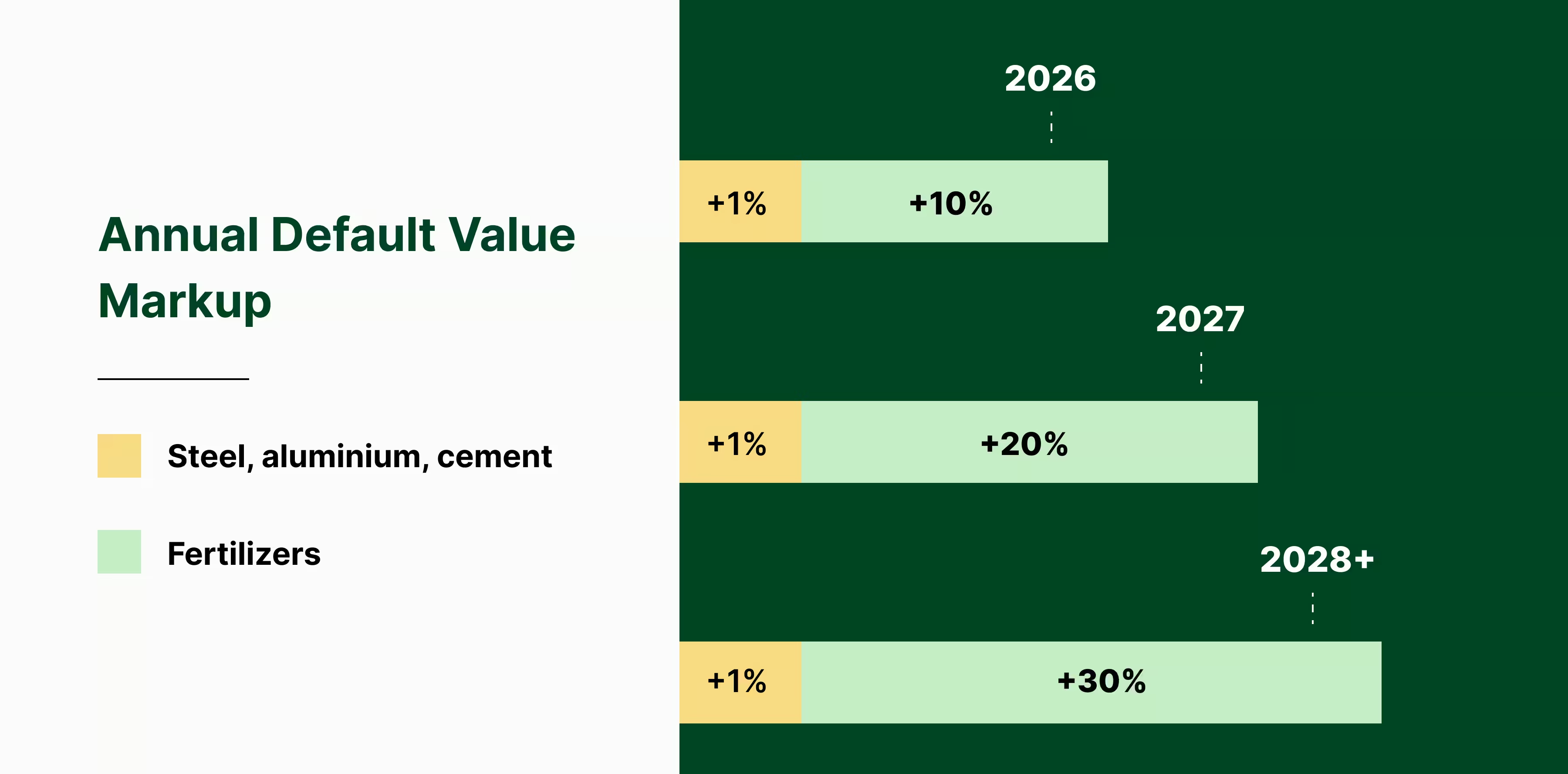
Indonesian-origin hot-rolled coil on default values could face CBAM costs of up to €580 per tonne in 2026 - against significantly lower costs for a producer submitting verified actual data. For exporters looking to avoid that exposure, the path is actual data - but the verification timeline is tighter than most assume. Verifiers cannot begin site-visit verification of 2026 data until the calendar year closes. Building the measurement infrastructure during 2026 is the only way to be ready for the 30 September 2027 declaration deadline.
What Non-Compliance Actually Costs
Choosing defaults carries a cost. Ignoring CBAM entirely carries a different order of risk.
The standard definitive phase penalty for failing to surrender sufficient CBAM certificates is €100 per tonne of CO2 e (adjusted annually for inflation), which applies on top of the original certificate obligation. More severely, under Regulation EU 2025/2083, any importer who exceeds the 50-tonne threshold and fails to secure "Authorized CBAM Declarant" status faces a punitive penalty rate of €300 to €500 per tonne of embedded emissions. The EU also retains the right to issue complete import bans on persistent offenders, transforming non-compliance from a financial penalty into a market access risk with no equivalent in standard customs compliance.
The Downstream Expansion: 180 Products, 2028
Beyond the penalties that apply to goods already in scope, the scope itself is expanding. On 17 December 2025, the European Commission published a draft regulation proposing to extend CBAM to approximately 180 downstream steel and aluminium-intensive products, with a proposed effective date of 1 January 2028. The European Parliament's Environment Committee considered the draft amendment report on 5 May 2026, proposing even tighter measures, including stricter accounting for scrap-based production and stronger anti-circumvention enforcement. While this remains a draft proposal working its way through the final rounds of legislative procedure, the direction is clear, and the product list is extensive. The proposed list covers fabricated metal structures, industrial machinery, automotive components, domestic appliances, power transformers and cables, and agricultural machinery.
Analysis by the Global Trade Research Initiative estimates that at least $1.1 billion of Indian exports would come into CBAM scope from 2028 if the proposal passes. The automotive components sector represents the largest single share - and this is where the urgency is most acute. The sector directs roughly 27% of its total output to the EU. The majority of that supply chain runs through Tier 2 and Tier 3 manufacturers: precision parts producers, forgings and castings suppliers, sub-assembly manufacturers who have never carried a carbon obligation, have no sustainability team, and in many cases have never measured their production emissions at all. These businesses have less than 18 months to build data infrastructure from scratch before a potential mandatory obligation lands. The 2026–2027 window is not an early-mover advantage for them. It is the only window.
UK CBAM: January 2027, No Transition, Tax from Day One
For exporters also serving the UK market, a parallel obligation arrives seven months later -and it is structurally different in almost every respect. The UK CBAM enters force on 1 January 2027, legislated under Finance Act 2026and administered by HMRC as a direct tax levy - not a certificate purchase system. Unlike the EU, which ran a two-year reporting-only transition period before any financial obligations applied, the UK CBAM has no transition phase for direct emissions - liability accrues from the first shipment of the year. Indirect emissions are deferred to 2029 at the earliest. The two regimes differ across almost every design parameter.
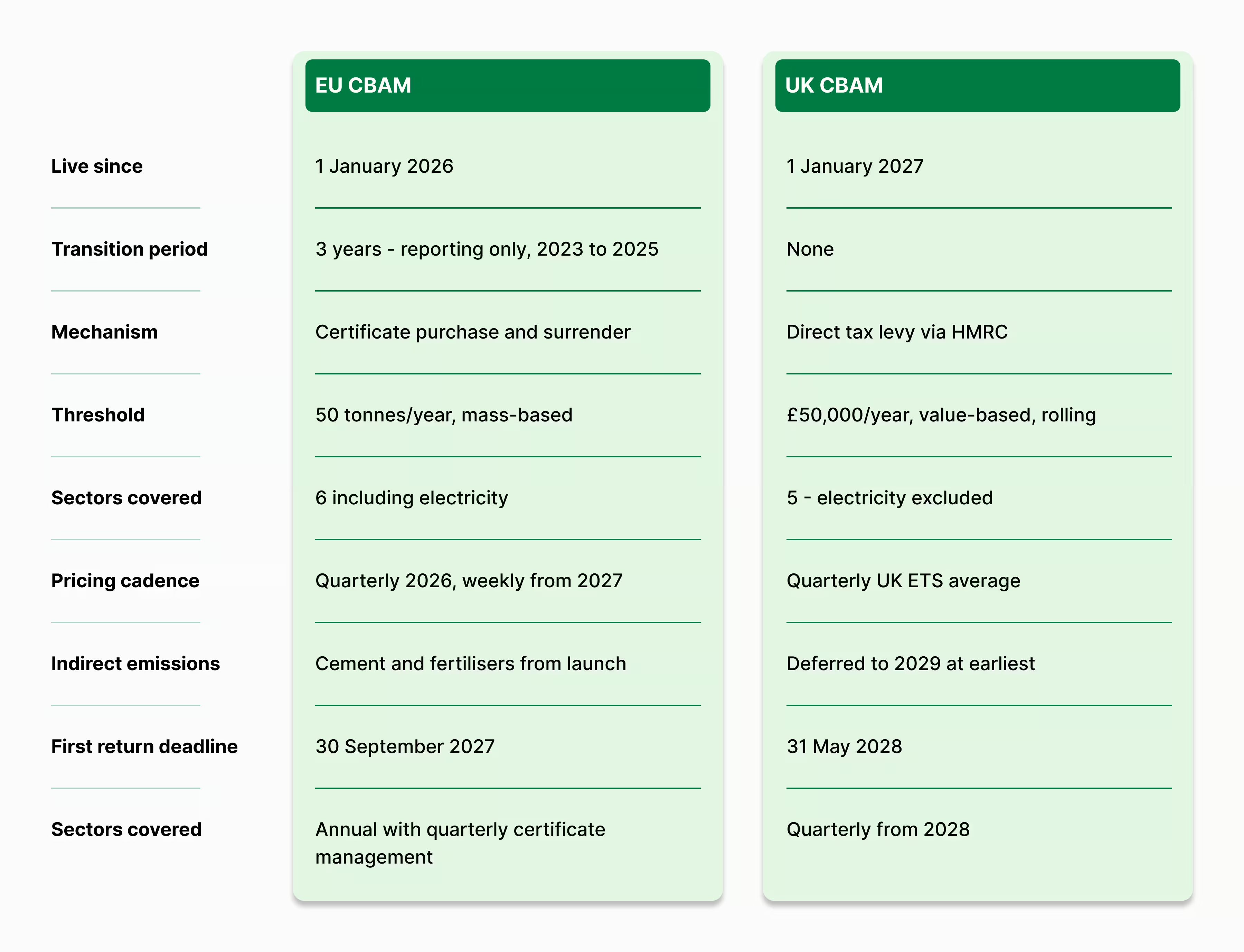
Of all these differences, the threshold design has the sharpest practical implication for exporters managing both markets. Because the UK uses a value-based threshold (£50,000) rather than a mass-based one (50 tonnes), an Indian engineering firm exporting high-value, low-weight specialised steel components could easily trigger UK CBAM liability while remaining entirely exempt from the EU framework. The two regimes operate on separate systems and cannot be managed under a combined compliance programme.
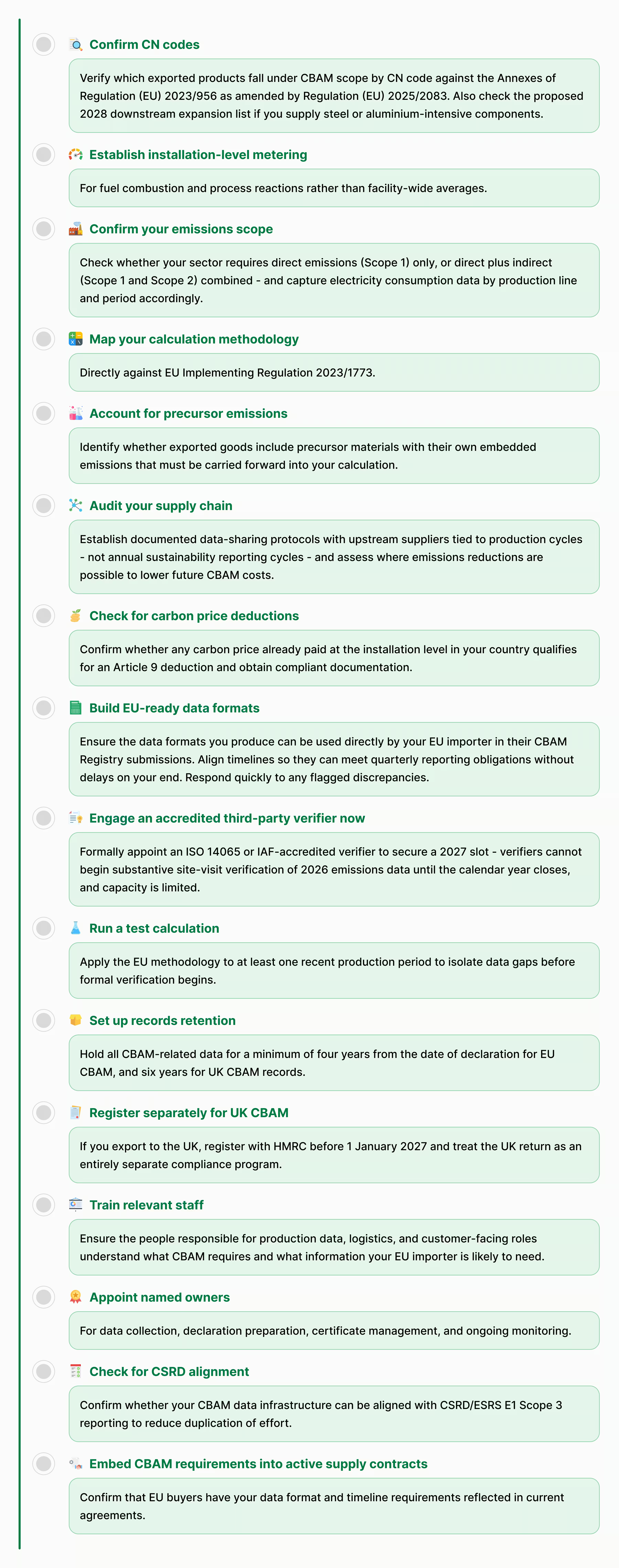
Pre-Compliance Checklist: How to Verify Where You Stand
Both regimes are now live or imminent. Most steps below apply to EU CBAM - if you also export to the UK, the HMRC registration step is a separate and additional obligation with its own deadline.
From Awareness to Action: Estimate Your CBAM Exposure
The businesses that will struggle most with CBAM in 2030 are not the ones facing the highest certificate costs. They are the ones who treated 2026 as a monitoring year rather than a building year. The compliance window and the preparation window are the same window - and it is already open.
If you want to understand the financial shape of your exposure before beginning the formal data build, the KarbonWise Free CBAM Calculator lets you estimate certificate costs based on your sector, import volumes, and the current EU ETS price. No sign-up required - a useful first-pass number before the detailed work begins For a more detailed conversation about your specific exposure, data gaps, or verification timeline, book a demo with our team.
{{cta}}
{{accordion}}
{{sources}}

Continue Reading

The EU Just Cut CSRD Reporting Requirements by 60%. Here Is What Actually Changed.
The EU has significantly changed CSRD reporting requirements. Explore the revised ESRS, what changed, who remains in scope, and what businesses need to do next.

SBTi FLAG Guidance v1.2: What Changed and What to Do Next
Learn what's new in SBTi FLAG Guidance v1.2, including updated deadlines, mandatory commodities, no-deforestation requirements, and practical steps for businesses.
How to conduct a double materiality assessment: A practical step-by-step guide (2026)
Learn how to conduct a Double Materiality Assessment with this practical step-by-step guide covering impact and financial materiality, IROs, stakeholder engagement, scoring, materiality matrices, and ESG reporting.


.avif)







.svg)
.svg)