The EU Just Cut CSRD Reporting Requirements by 60%. Here Is What Actually Changed.
The EU has significantly changed CSRD reporting requirements. Explore the revised ESRS, what changed, who remains in scope, and what businesses need to do next.


.svg)
Table of Contents


On 3 July 2026, the European Commission adopted revised European Sustainability Reporting Standards and a new voluntary reporting standard, changing how sustainability reporting will work under the CSRD.
If your team has spent the last year building a sustainability reporting programme around the original ESRS, some of that work just became outdated.
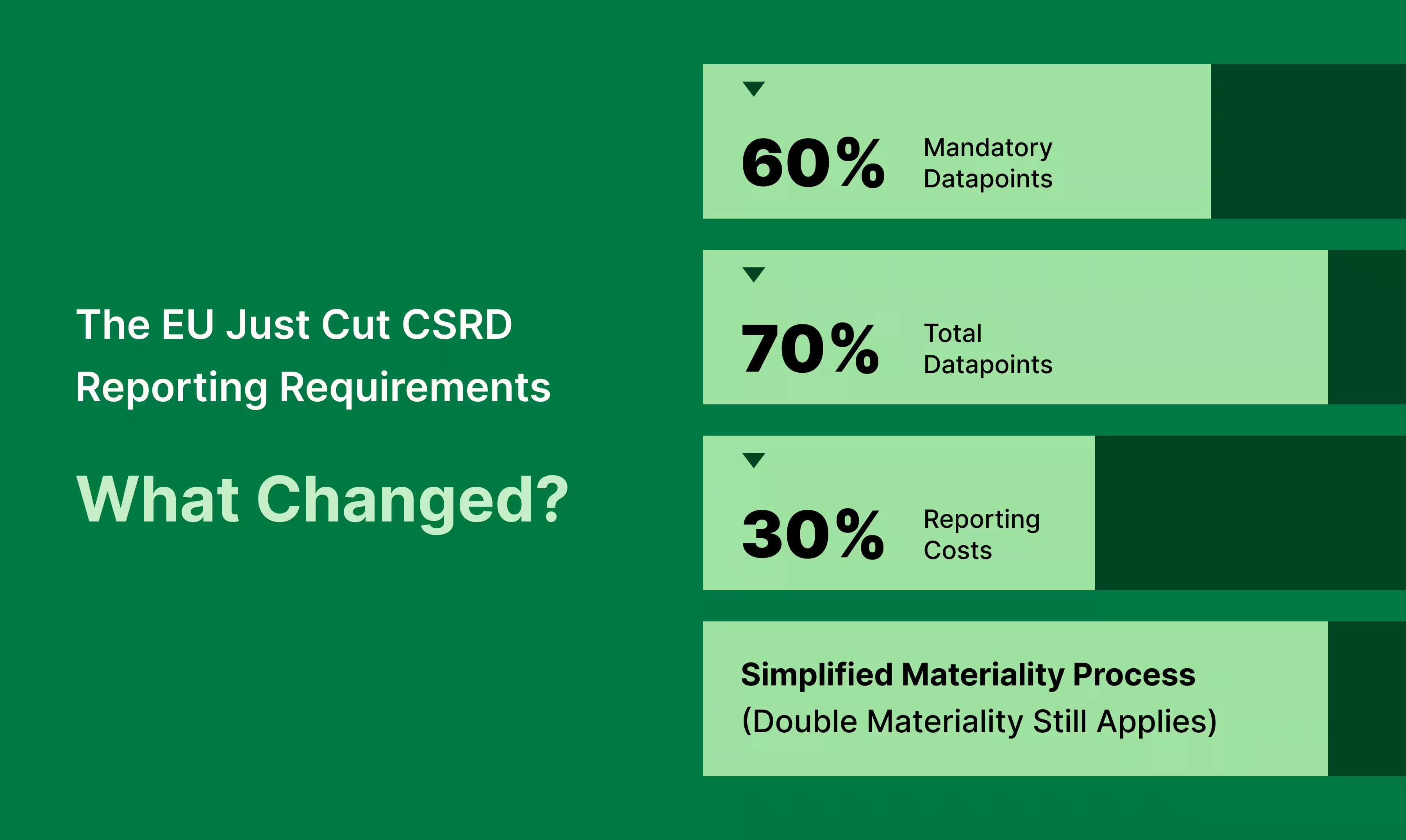
And a new rule now limits what large companies can demand from smaller suppliers.
That sounds like good news. And mostly it is. But fewer datapoints does not mean less work. And companies that misread this simplification as a signal to slow down will be in trouble when FY2027 arrives.
Why the EU Rewrote the ESRS
When the original ESRS landed in July 2023, the reaction from companies was pretty consistent - ‘This is too much’. Roughly 1,000 datapoints across cross-cutting and topical standards. A materiality process that required assessing every possible impact, risk, and opportunity before concluding what to report. Reporting burdens that smaller teams simply could not resource.
The European Commission heard that feedback. In February 2025, as part of its Omnibus I simplification package, it asked EFRAG to go back and simplify the standards. EFRAG delivered its technical advice in December 2025. The Commission reviewed it, made targeted adjustments, and on 3 July 2026, adopted the revised delegated act.
The revised ESRS will now go to the European Parliament and Council for a two-month scrutiny period, extendable by a further two months. If neither institution objects, the standards enter into force and apply to financial years beginning on or after 1 January 2027. Early adoption for FY2026 is also permitted once the act formally enters into force.
First: Are You Still in Scope?
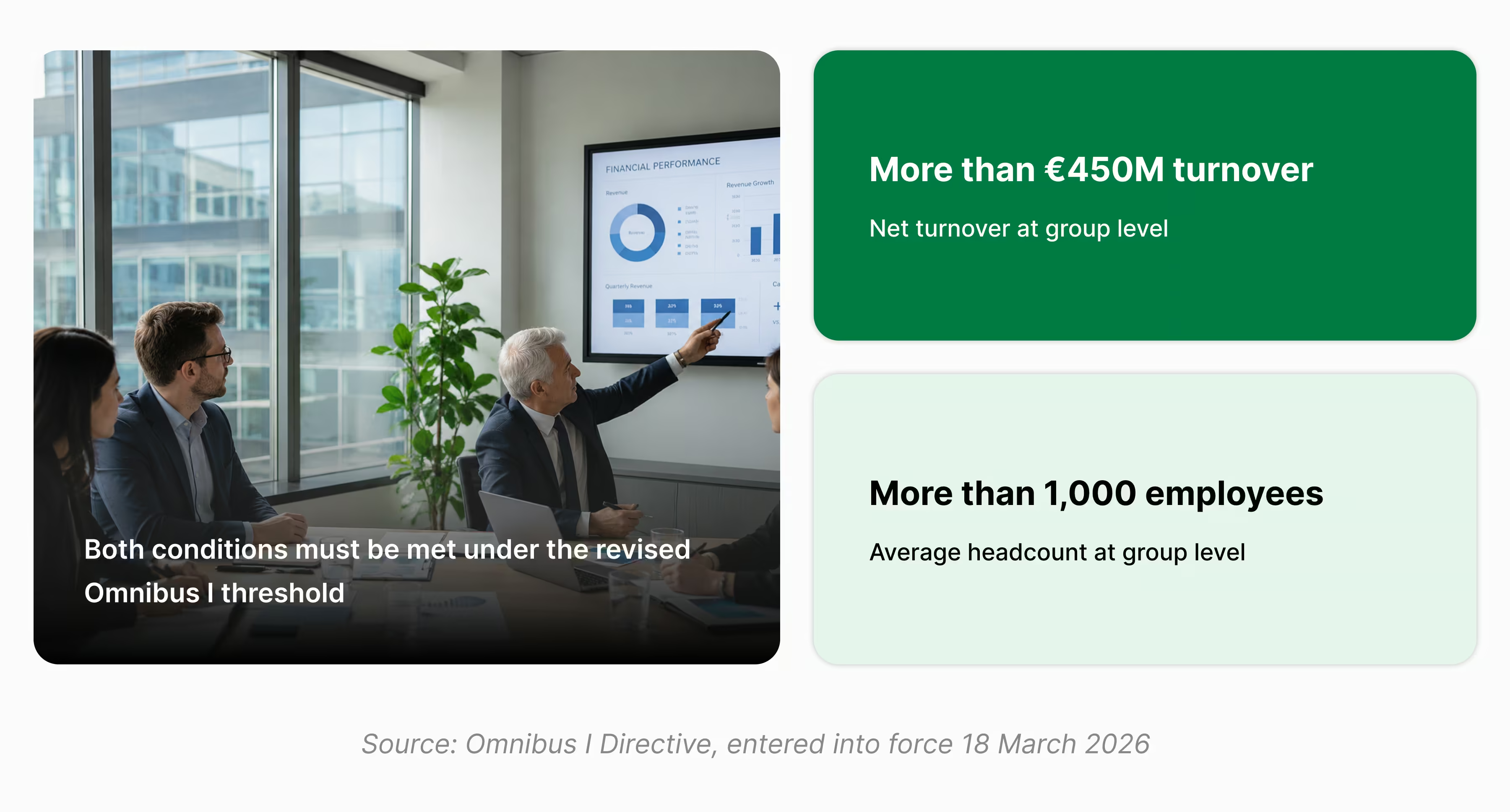
The Omnibus I Directive, which entered into force on 18 March 2026, narrowed the CSRD scope significantly. CSRD now applies only if you meet both:
- More than 1,000 employees
- More than 450 million euros net turnover
That is a dual threshold, not two of three. Many mid-market companies that were preparing under the original scope may now be out of mandatory scope.
If you were originally a Wave 2 or Wave 3 company, run your numbers again before investing further in compliance infrastructure. If you do not meet both thresholds, your mandatory CSRD position may have changed.
One important nuance: if you were already a Wave 1 reporter, the story is more complicated. Member States have until 19 March 2027 to transpose the Omnibus provisions into national law, and some may offer exemptions. But Wave 1 companies should continue reporting through FY2026 unless their national regulator has confirmed otherwise.
The Five Changes That Actually Matter
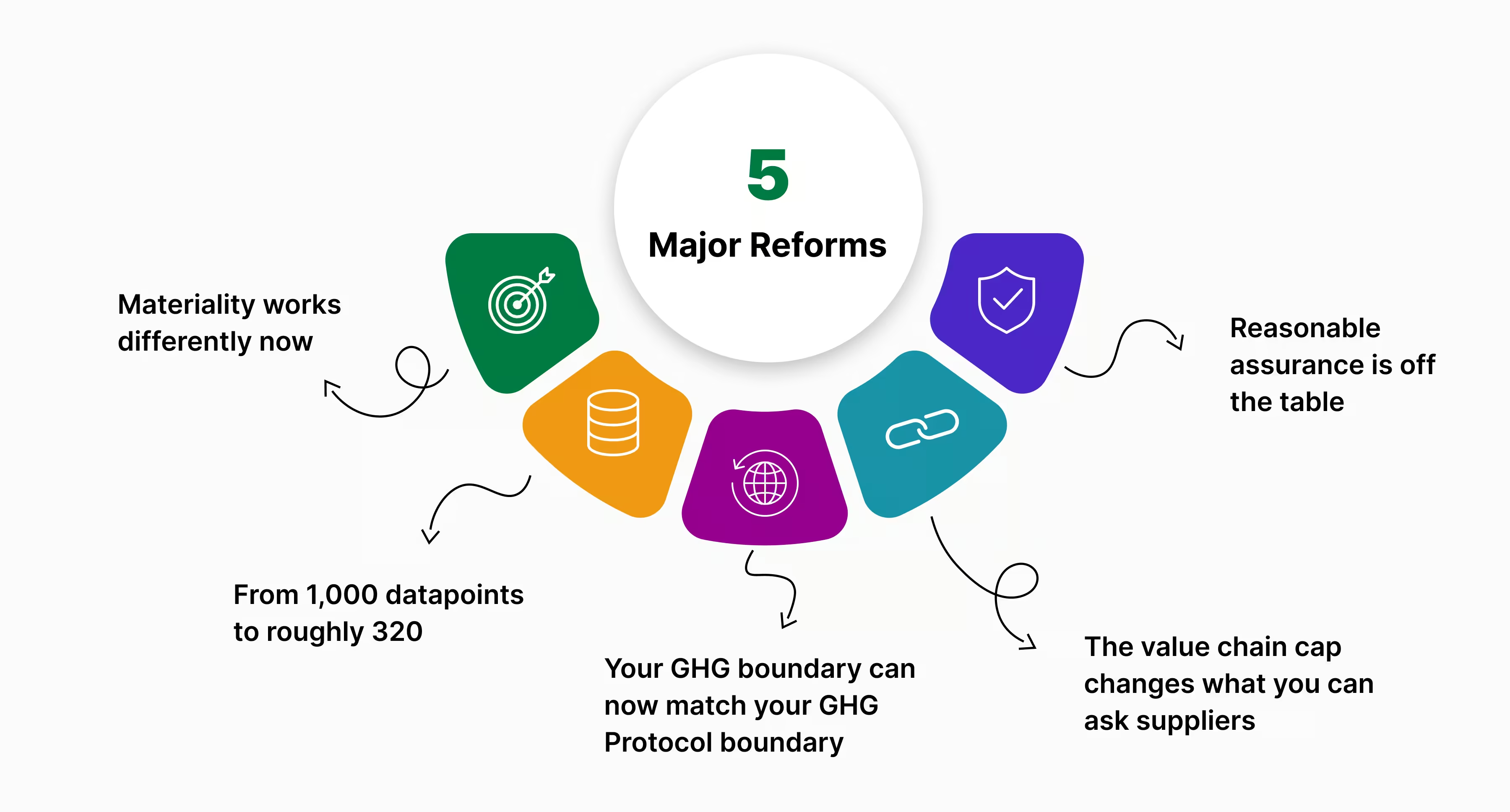
1. Materiality works differently now
This is the biggest practical change, and if you only take one thing from this blog, make it this.
Under the original ESRS, companies had to work bottom-up. You assessed every possible impact, risk, and opportunity across your operations and value chain, then concluded what was material. In practice that meant months of work, enormous spreadsheets, and reports full of disclosures on topics that were not actually relevant to the business.
The revised ESRS flip that. You now start top-down, from your strategy and business model. You assess materiality at the topic or sub-topic level. If the answer is obviously non-material from the business model, you do not need to document a lengthy analysis to prove it. And the standards now explicitly say: Do not disclose information that is not material.
The practical difference is significant. Instead of months spent documenting every possible impact, risk, and opportunity before concluding what is relevant, you begin from your strategy and business model and work down. If a topic is clearly non-material from where you sit, you do not need a lengthy paper trail proving it.
Double materiality still applies - the obligation has not moved. Only the route to it has
2. From 1,000 datapoints to roughly 320
The original ESRS had around 1,000 datapoints. The revised ESRS brings that down to approximately 320 mandatory datapoints - a reduction of roughly two-thirds, not a marginal adjustment to the existing requirements.
What got cut:
- Workforce pay metric granularity (ESRS S1)
- Supply chain narrative in human rights (ESRS S2)
- Secondary microplastics (ESRS E2)
- Several biodiversity datapoints (ESRS E4)
What stayed heavy?
Climate. ESRS E1 has seen proportionally fewer cuts than everything else. If you thought the datapoint reduction would ease your GHG reporting burden, it has not eased it as much as the headline number suggests. Emissions data, scenario analysis, and transition plan disclosures remain substantive.
One more thing that did not make many headlines: sector-specific ESRS standards have been discontinued entirely. The original CSRD included a mandate to develop standards for specific industries. That mandate has been removed under the Omnibus reform. If your team was waiting for your sector-specific standard before finalising your materiality assessment, it is not coming.
3. Your GHG boundary can now match your GHG Protocol boundary
This one flew under the radar in most of the coverage but it matters enormously for companies reporting under both ESRS and ISSB.
The original ESRS required the operational control approach for defining GHG reporting boundaries. The GHG Protocol and ISSB's IFRS S2 allow both financial control and operational control. So companies using financial control for their GHG inventory had to maintain a second inventory just for ESRS. That duplication was expensive and produced numbers that did not reconcile cleanly.
The revised ESRS now allow both approaches. One GHG inventory can serve both reporting frameworks. Non-material subsidiaries excluded from consolidated financial statements can also be excluded from the sustainability reporting boundary.
If your team has been running parallel GHG inventories, this change alone makes the revision worthwhile.
4. The value chain cap changes what you can ask suppliers
The Omnibus I package introduced something called the value chain cap, and it is now embedded in the revised ESRS.
In practice, it means this: if you are a large company subject to CSRD, you cannot require suppliers with 1,000 employees or fewer to provide more sustainability information than the new voluntary standard covers.
There is one important exception that most coverage glosses over. The cap does not apply to gross Scope 1, 2 and 3 GHG emissions. You can still ask any supplier, of any size, for their emissions data. That request is now more standardised, more expected, and harder to push back on.
If your procurement team has been building supplier questionnaires based on the full original ESRS datapoint list, those questionnaires need to be reviewed.
5. Reasonable assurance is off the table
Under the original CSRD, the plan was to move from limited assurance to reasonable assurance over time. That transition has been removed. Sustainability reports will stay at limited assurance going forward.
For companies that had been building toward a reasonable assurance standard in their data collection and audit trails, this takes some pressure off. But it does not mean assurance is less rigorous than before. Limited assurance still requires traceable primary source documentation for every material disclosure. What changed is the ceiling, not the floor.
What Is the New Voluntary Standard and Who Is It For?
Alongside the revised mandatory ESRS, the Commission adopted something else: a voluntary sustainability reporting standard for companies that are not in mandatory CSRD scope.
Think of it as the baseline, not the full ESRS. Smaller companies, private businesses, and non-EU suppliers can use it to demonstrate ESG performance to customers, investors, or lenders without the full ESRS burden. It gives them a structured, proportionate way to report without being dragged into a framework that was never designed for their size.
But here is the part that directly affects large CSRD companies. This voluntary standard now defines the maximum you can ask from suppliers with fewer than 1,000 employees. This is not guidance but a legal limit. If a supplier asks what you can require them to report, the answer from 2027 onwards is: no more than this, except for their GHG emissions.
For procurement teams that have been sending sprawling sustainability questionnaires to every supplier in the chain, that needs to change before 2027.
The voluntary standard applies from financial years starting on or after 1 January 2027.
If You Are Outside the EU, Read This Section
The value chain trickle-down is real and it is moving faster than most non-EU companies realise.
If you are based in India, the UAE, Saudi Arabia, or the UK and you supply EU customers in scope for CSRD, two things have shifted. First, if your business has fewer than 1,000 employees, your EU customers can no longer send you a full ESRS questionnaire. They are capped at the voluntary standard. Second, they can still ask for your Scope 1, 2 and 3 GHG emissions data regardless of your size, and that ask is now backed by a formal regulatory framework rather than a customer preference.
There is also a bigger development coming. EFRAG is developing a dedicated standard for non-EU groups with significant EU turnover, called the ESRS for Third-Country Groups. A public consultation on that draft standard is expected before the end of 2026. If your business has material EU revenue or operations, that standard could impose mandatory reporting obligations from 2027 onwards. Watch the EFRAG website for the consultation launch.
What To Do Right Now
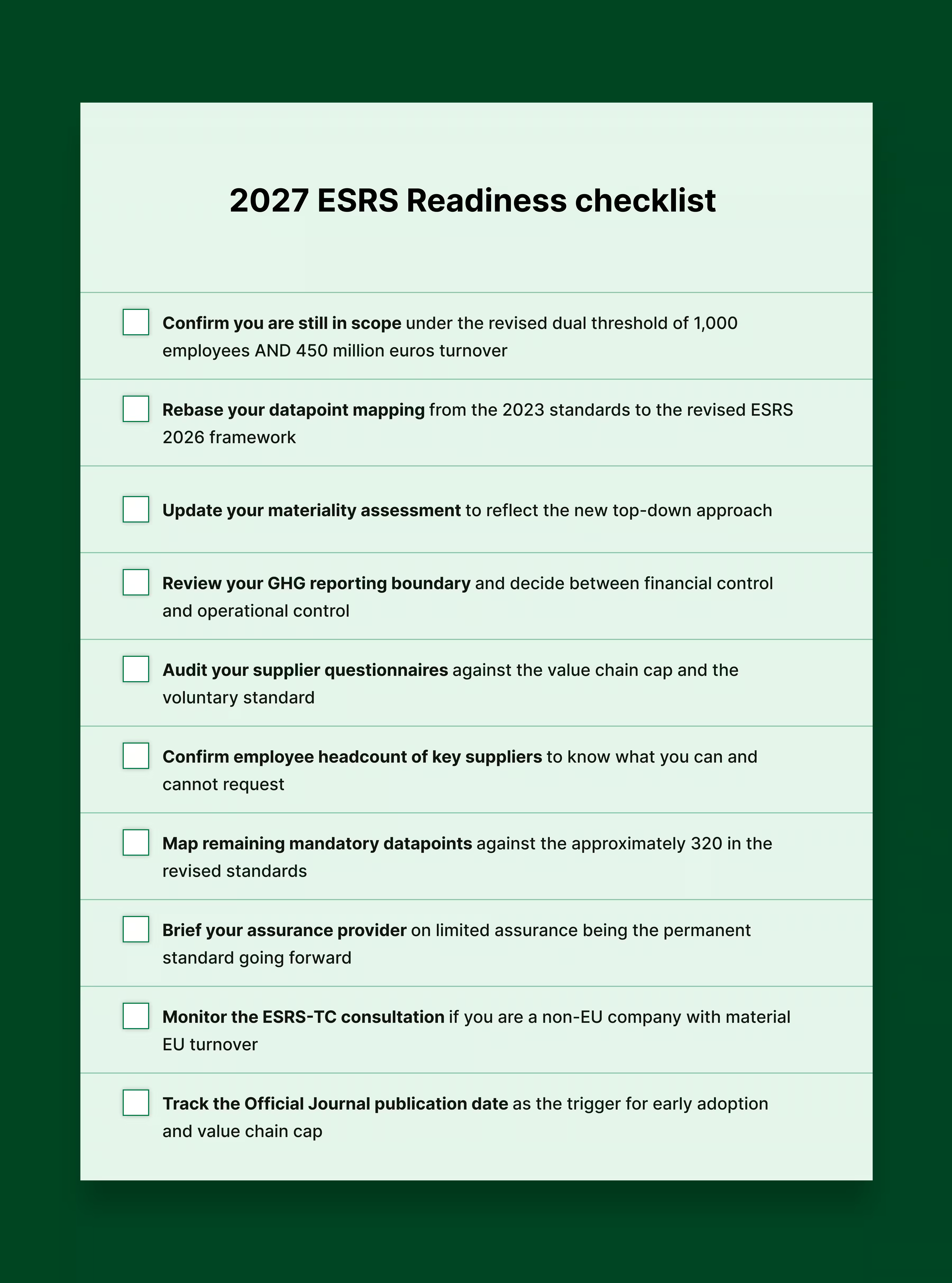
The revised ESRS are not yet legally in force. Scrutiny runs until September or October 2026 at the earliest. But waiting for the Official Journal publication before starting your preparation is not a strategy.
If you are reporting for FY2026 under the 2023 ESRS: You can apply certain reliefs from the revised standards now, but you must clearly state in your report which version you are applying. Do not assume your auditor or assurance provider will flag this for you.
If you are preparing for your first CSRD report for FY2027: Build against the revised ESRS from the start. Stop mapping data against the 2023 datapoint list. The revised standards are what you will be audited against.
If you are a supplier to a CSRD company: Know your employee headcount. If you are below 1,000, you have new protections on what customers can require from you. But your emissions data is still required to be furnished.
If you are a non-EU company: Monitor the ESRS-TC consultation. It is the standard most likely to affect your business and most companies have not started tracking it yet.
On assurance: Limited assurance is now the permanent standard. If you have been building data infrastructure toward reasonable assurance requirements, recalibrate your effort levels. The bar has been set, and it is not rising further under the current framework.
5 Mistakes Companies Are Making Right Now
Treating 60% fewer datapoints as 60% less work. The materiality assessment still requires documented judgement. GHG data still needs primary source evidence. Assurance providers still need audit trails. The reporting is lighter. The infrastructure underneath it is not.
Still building against the 2023 datapoint list. If your team is mapping data against the original 1,000 datapoints, stop. Rebase against the revised standards before you get any further. The gap analysis now is far less painful than the rework in late 2026.
Misunderstanding the value chain cap. The cap limits what you can ask suppliers with fewer than 1,000 employees. It does not limit GHG emissions requests. Procurement teams that brief suppliers with "you are now protected from sustainability questionnaires" are giving incorrect information.
Assuming you are still in scope without checking. The dual threshold of more than 1,000 employees AND more than 450 million euros in turnover is new. Companies that assumed they were in scope under the original two-of-three test may have fallen out. Run your numbers before investing further.
Waiting for sector-specific standards that are not coming. The mandate to develop sector-specific ESRS has been removed. If your materiality assessment was parked pending that guidance, it needs to restart against the general standards now.
How KarbonWise Fits Into This
Simplification applies to the report, not to the data behind it.
You still need a live Scope 1, 2 and 3 inventory. You still need every emission figure tagged to a primary source. You still need a materiality assessment that holds up in front of an assurance provider. You still need to collect supplier data within whatever boundaries the value chain cap allows. The output is lighter. The infrastructure still needs to be there.
KarbonWise's ESG reporting platform is built around that infrastructure. Carbon accounting across Scope 1, 2 and 3 is calculated against the GHG Protocol and tagged to source at the point of entry, which means your report arrives pre-documented rather than requiring a separate evidence run before audit. For companies managing supplier data under the new value chain rules, KarbonWise's supplier engagement tools make it straightforward to collect verified emissions data within the boundaries the revised standards allow.
The companies that come out of this in good shape are not the ones that read "60% fewer datapoints" and assume the work is done. They are the ones that use the revision as an opportunity to clean up their data infrastructure, revisit their materiality process, and sort out supplier engagement before FY2027.
Book a demo and we will show you exactly where your gaps are.
{{cta}}
{{accordion}}
{{sources}}

Continue Reading

Australia's Mandatory Climate Reporting (2026): AASB S2 Deadlines, Groups & Readiness Checklist
Everything Australian organisations need to know about AASB S2 climate reporting, reporting groups, deadlines and compliance readiness.

SBTi FLAG Guidance v1.2: What Changed and What to Do Next
Learn what's new in SBTi FLAG Guidance v1.2, including updated deadlines, mandatory commodities, no-deforestation requirements, and practical steps for businesses.

How to conduct a double materiality assessment: A practical step-by-step guide (2026)
Learn how to conduct a Double Materiality Assessment with this practical step-by-step guide covering impact and financial materiality, IROs, stakeholder engagement, scoring, materiality matrices, and ESG reporting.


.avif)








.svg)
.svg)