Carbon Accounting vs Carbon Footprint
Understand the difference between carbon footprint and carbon accounting, and how each helps businesses measure, manage, and report greenhouse gas emissions.
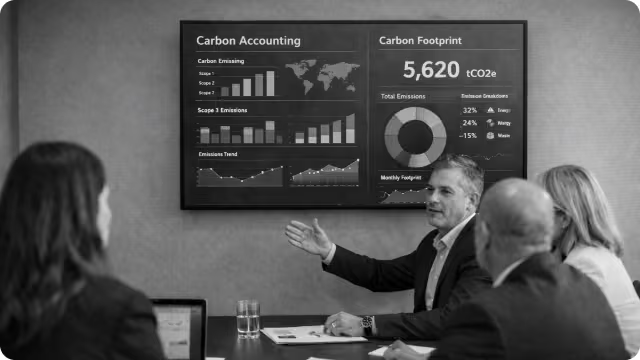

.svg)
Table of Contents


This blog sets the foundation for understanding the difference between carbon footprint and carbon accounting, and why each serves a distinct purpose for businesses. Understanding this difference helps businesses choose the right approach for measurement, reporting, and decision-making, rather than applying the wrong tool to the wrong objective.
What Is a Carbon Footprint?
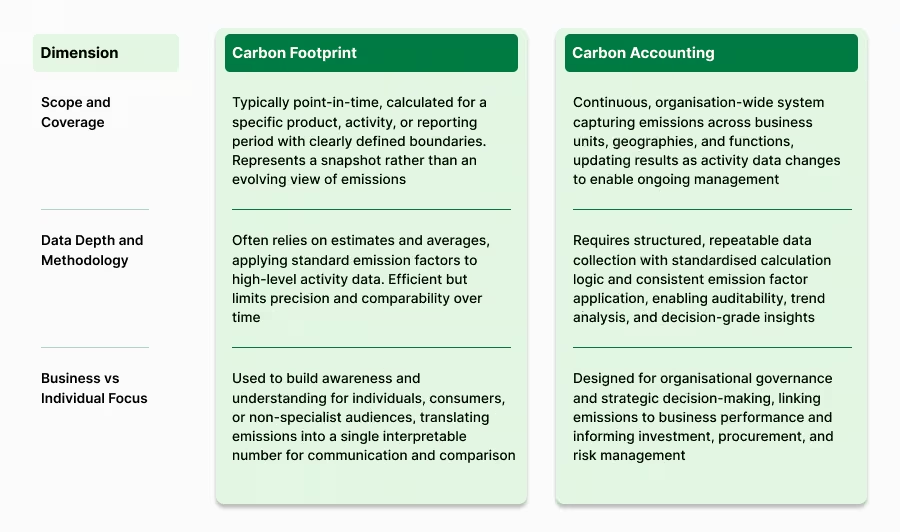
A carbon footprint quantifies the greenhouse gas emissions linked to a specific activity, product, individual, or organisation, reported as CO₂e. It is always defined by a limited boundary, such as a product lifecycle, an event, or emissions over a fixed time period.
Footprint calculations may include direct and indirect emissions, but coverage is often selective. Direct emissions typically come from fuel use or on-site activities, while indirect emissions can include electricity consumption or parts of the supply chain. In many cases, indirect emissions are estimated at a high level rather than comprehensively measured.
Because of this, carbon footprints are primarily used for standalone assessments, including product labels, event calculations, and awareness-focused reporting. They provide visibility and comparability, but do not support ongoing emissions management.
What Is Carbon Accounting?
Carbon accounting is a continuous organisational process for measuring, managing, and reporting emissions across business operations and the value chain. It goes beyond calculation, establishing a system for consistent data collection and review over time.
By tracking emissions across reporting periods, carbon accounting enables governance, performance monitoring, and compliance. It underpins ESG disclosures, regulatory reporting, and net-zero strategies, making it essential for organisations that need reliable, auditable emissions data rather than one-off estimates.
Carbon Accounting vs Carbon Footprint - Core Differences
Role of Scope 1, Scope 2, and Scope 3 Emissions
How Scope 1, Scope 2, and Scope 3 emissions are treated plays a major role in determining whether an approach is suitable for high-level insight or enterprise-level management.
How Carbon Footprint Uses Scopes 1, 2, and 3
Carbon footprint studies may reference Scope 1, Scope 2, and Scope 3 emissions, but coverage is often partial or simplified. The scope boundary is usually shaped by the purpose of the assessment, data availability, and time constraints rather than by a requirement for completeness.
In practice, Scope 3 emissions are frequently excluded or narrowly estimated in footprint calculations. Upstream and downstream activities such as supplier production, product use, or end-of-life treatment are complex to quantify and are therefore often reduced to high-level assumptions. This makes carbon footprints useful for indicative insights, but limits their ability to reflect full value-chain impact.
How Carbon Accounting Manages Scope 1, 2, and 3
Carbon accounting treats Scope 1, Scope 2, and Scope 3 emissions as integrated components of a single emissions system. The objective is not selective inclusion, but progressive expansion towards full value-chain visibility as data maturity improves.
Emissions across all three scopes are tracked continuously and recalculated over time, allowing organisations to monitor changes, identify hotspots, and prioritise reduction efforts. This ongoing approach is critical for meeting reporting requirements, managing supplier-related emissions, and demonstrating credible progress against climate targets.
Use Cases - When to Use What?
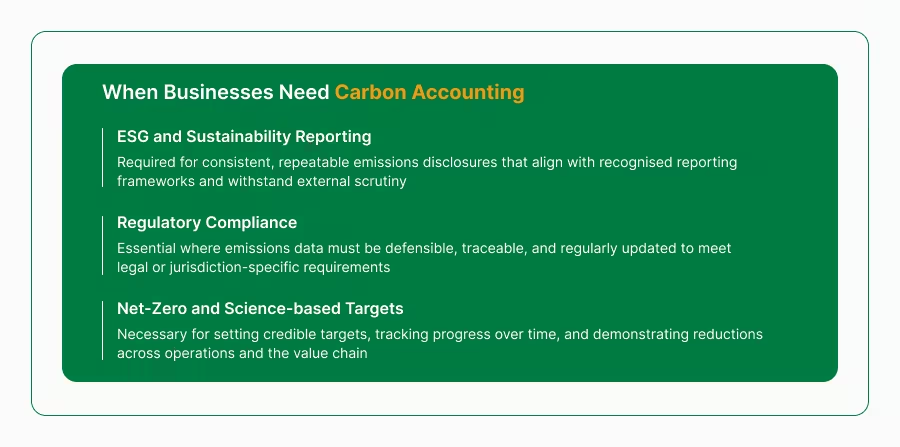
The choice between carbon footprint and carbon accounting depends on what an organisation is trying to achieve and how it plans to use emissions data.
{{flipcards}}
Carbon Accounting vs Carbon Footprint in ESG & Reporting
ESG reporting places different demands on emissions data, making the choice between footprinting and accounting especially significant.
Carbon Footprint and ESG Limitations
Carbon footprints can support contextual ESG narratives, but they have clear limitations in formal reporting. As they are typically one-time or infrequent assessments, they do not provide the continuity required to demonstrate performance trends or year-on-year improvement.
In addition, carbon footprints often lack audit readiness. Assumptions, high-level estimates, and incomplete scope coverage can make results difficult to verify or defend under regulatory or assurance processes. This restricts their usefulness in environments where disclosures must be consistent, comparable, and traceable.
Carbon Accounting for ESG, CSRD & Net Zero
1. Continuous monitoring
Enables organisations to track emissions across reporting periods, supporting progress measurement rather than static disclosure.
2. Audit-ready and regulation-aligned data
Provides structured, standardised datasets that can withstand assurance requirements and align with evolving ESG and climate regulations.
3. Credible net-zero tracking
Supports target setting, interim milestones, and transparent reporting of reductions across operations and the value chain. This expectation reflects the growing emphasis on demonstrable, long-term emissions reductions highlighted in global climate mitigation pathways.
Common Misconceptions Businesses Have
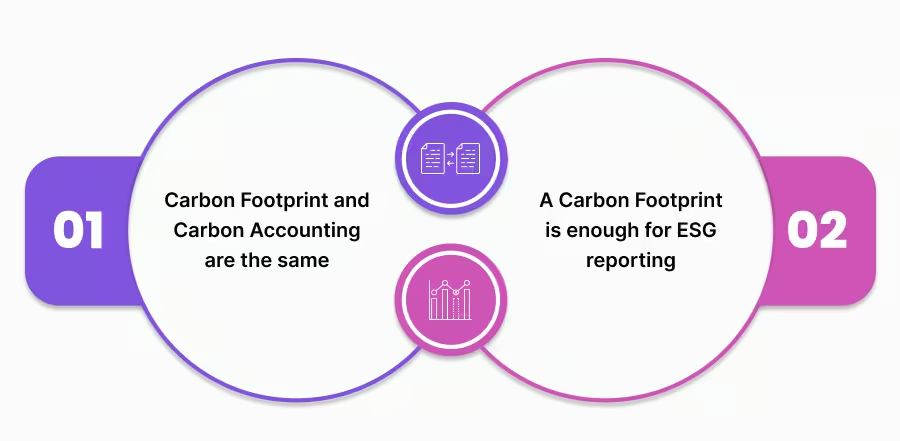
a) “Carbon Footprint and Carbon Accounting are the same”
This assumption overlooks the hierarchy between the two. A carbon footprint is an output, focused on quantifying emissions for a defined boundary, while carbon accounting is the system that governs how emissions are measured, updated, and managed across an organisation. Treating them as interchangeable often leads to underestimating the level of structure required for credible emissions management.
b) “A Carbon Footprint is enough for ESG reporting”
While a carbon footprint can support high-level disclosures, it does not meet the demands of enterprise ESG reporting. Reporting frameworks increasingly require consistency, traceability, and repeatability, which cannot be achieved through isolated calculations. As expectations rise, organisations need more robust systems to support assurance, regulatory alignment, and long-term climate commitments.
How KarbonWise Bridges the Gap
From Carbon Footprint to Full Carbon Accounting
KarbonWise enables organisations to move beyond isolated footprint calculations to enterprise-grade carbon accounting by unifying data, systems, and methodologies. Rather than relying on fragmented spreadsheets or one-off studies, the platform connects operational activity data with emissions factors, automates calculations across Scope 1, Scope 2, and Scope 3, and scales insights up to enterprise level. This makes it possible to shift from approximate estimates to structured, repeatable measurement capable of supporting formal reporting and strategy.
Automated Scope 1, 2, and 3 Tracking
KarbonWise automates emissions tracking by ingesting data directly from core business systems such as procurement, utilities, and ERP, reducing manual work and increasing data completeness. It supports supplier-level data collection and refines estimates where inputs are missing, progressively improving Scope 3 coverage. This approach helps organisations achieve full value chain visibility – from energy consumption to logistics and supplier emissions – in a way that is both scalable and traceable.
Conclusion
The difference between carbon accounting and carbon footprint is not a matter of preference, but of purpose and scale. A carbon footprint provides a bounded view of emissions, useful for understanding impact in a specific context. Carbon accounting, however, establishes the system through which emissions are consistently measured, governed, and improved across an organisation. In this sense, carbon footprinting sits within carbon accounting, not alongside it.
As expectations around climate disclosure and accountability continue to rise, businesses are increasingly judged not just on what they measure, but on how reliably and consistently they measure it. This is where carbon accounting becomes a necessity rather than an option.
The right approach depends on an organisation’s growth stage, regulatory exposure, and ESG ambitions. Early-stage or small organisations may begin with carbon footprinting to gain directional insight. As operations expand, supply chains grow more complex, or reporting requirements intensify, the limitations of one-off assessments become more apparent.
For businesses facing compliance obligations, external scrutiny, or net-zero commitments, carbon accounting provides the structure needed to move from intention to execution. Choosing the right approach is ultimately about aligning emissions measurement with the real demands placed on the business, today and in the future.
Actionable Insights Beyond Measurement
- Reduction strategies – The platform enables users to explore emissions trends, identify high-impact areas, and prioritise reduction initiatives rather than just reporting numbers. Interactive dashboards and anomaly detection help teams respond quickly to emerging issues.
- Progress tracking toward net zero – KarbonWise supports structured net-zero planning by linking emissions baselines to reduction actions and reporting. It aligns data with frameworks such as CSRD and other corporate reporting standards, ensuring the organisation can demonstrate credible progress over time.
{{cta}}
{{accordion}}
{{sources}}




Continue Reading

Primary vs Secondary Emissions Data: Key Differences and When to Use Each
Learn the key differences between primary and secondary emissions data, when to use each, and how better data quality supports more accurate carbon accounting and Scope 3 reporting.

Netflix, Binge-Watching & the Hidden Carbon Footprint of Streaming Culture
Streaming feels effortless, but every Netflix session relies on data centres, networks, and devices that consume energy continuously. Discover the hidden carbon footprint of streaming culture and learn simple ways to reduce your digital impact.



.avif)








.svg)
.svg)