Importance of Carbon Accounting in Net-Zero Strategy
Carbon accounting enables businesses to measure emissions, set targets, and drive effective net-zero strategies through data-driven decision-making.


.svg)
Table of Contents


Carbon accounting transforms climate ambition into measurable action. By converting operational activity into quantified emissions data, organisations can identify where reductions will deliver the greatest impact. This enables data-driven decision-making across procurement, energy management, logistics, and product design, ensuring decarbonisation efforts are targeted rather than symbolic.
It also strengthens regulatory compliance and stakeholder confidence. With expanding disclosure requirements and investor scrutiny, businesses are expected to present transparent, auditable emissions data. A structured carbon accounting framework supports sustainability reporting, improves governance oversight, and aligns climate strategy with financial and operational planning.
Differentiating Carbon Accounting, Carbon Reporting, and Carbon Management
Carbon accounting, carbon reporting, and carbon management are interconnected but distinct functions within a net-zero strategy. Carbon accounting focuses on measurement. It establishes emissions boundaries, compiles greenhouse gas data, and produces a structured GHG inventory aligned with recognised methodologies such as the Greenhouse Gas Protocol. Without accurate accounting, subsequent reporting and reduction strategies lack credibility.
Carbon reporting is the disclosure of that data to regulators, investors, and stakeholders through sustainability reports or climate disclosures. Carbon management goes further by using emissions data to implement reduction initiatives, set targets, and track progress over time. Measurement provides the foundation, reporting ensures transparency, and management drives decarbonisation outcomes.
Although often used interchangeably, carbon accounting, carbon reporting, and carbon management serve different roles within a net-zero framework. Understanding how they function together helps organisations structure climate action more effectively.

Steps to Use Carbon Accounting for Achieving Net-Zero Emissions
Carbon accounting becomes strategically valuable when it is embedded into a structured decarbonisation pathway. The following steps outline how organisations can translate emissions measurement into measurable progress towards net-zero.

01. Measuring Scope 1, 2, and 3 Emissions
The first step is establishing a complete greenhouse gas inventory across Scope 1, 2, and 3 emissions as defined by the Greenhouse Gas Protocol. Scope 1 covers direct emissions from owned or controlled sources. Scope 2 accounts for indirect emissions from purchased electricity, heat, or steam. Scope 3 includes upstream and downstream value chain emissions, often representing the largest share of total impact.
Clear organisational and operational boundaries must be defined to avoid double counting or omission. Establishing these parameters ensures consistency across reporting periods and strengthens comparability with industry benchmarks.
02. Establishing a Carbon Baseline
Once emissions are measured, organisations must define a baseline year against which future reductions will be tracked. This involves consolidating activity data such as fuel consumption, electricity usage, procurement records, and logistics information into a verified emissions profile.
A credible baseline highlights high-impact emission sources across operations and supply chains. Identifying these hotspots allows businesses to prioritise reduction strategies where they will deliver the greatest environmental return.
03. Setting Science-Based Reduction Targets
With a defined baseline, organisations can establish short-term and long-term emissions reduction targets aligned with global climate pathways. Many businesses align their targets with guidance from the Science Based Targets initiative to ensure consistency with limiting global warming.
Targets should be specific, time-bound, and integrated into operational planning. Clear interim milestones strengthen accountability and prevent long-term commitments from remaining theoretical.
04. Implementing Reduction Strategies
Reduction strategies translate targets into operational change. This may include improving energy efficiency, transitioning to renewable electricity procurement, optimising logistics networks, and redesigning products to reduce lifecycle emissions.
Engaging suppliers is particularly critical for Scope 3 emissions, where collaborative decarbonisation efforts can significantly influence overall performance. Structured carbon accounting ensures progress is measurable rather than assumed.
05. Offsetting Residual Emissions
After maximising feasible reductions, residual emissions may remain. In such cases, verified carbon credits can be used to compensate for unavoidable emissions, provided they meet recognised quality and additionality standards.
Offsets should complement, not replace, direct reduction efforts. A credible net-zero strategy prioritises internal decarbonisation before relying on external compensation mechanisms.

Challenges and Considerations in Carbon Accounting Implementation
Implementing carbon accounting at scale presents operational and governance challenges. While frameworks provide methodological guidance, translating theory into accurate, organisation-wide emissions data requires cross-functional coordination and sustained leadership commitment.
{{blurb}}
Case Studies of Businesses Using Carbon Accounting to Achieve Net Zero
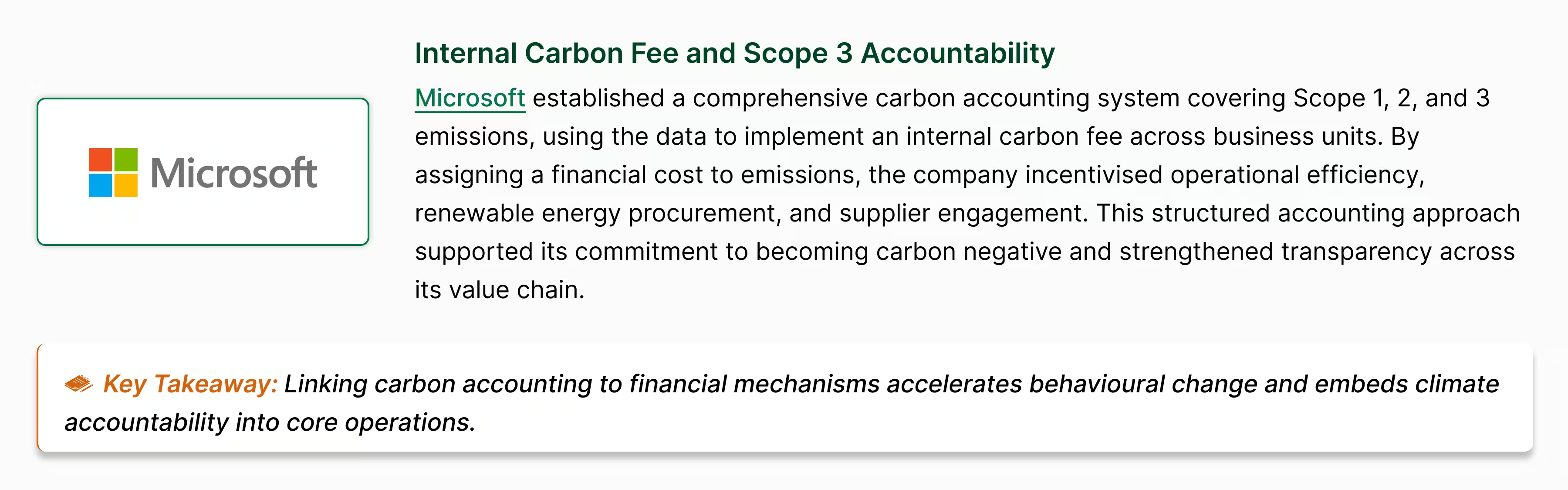
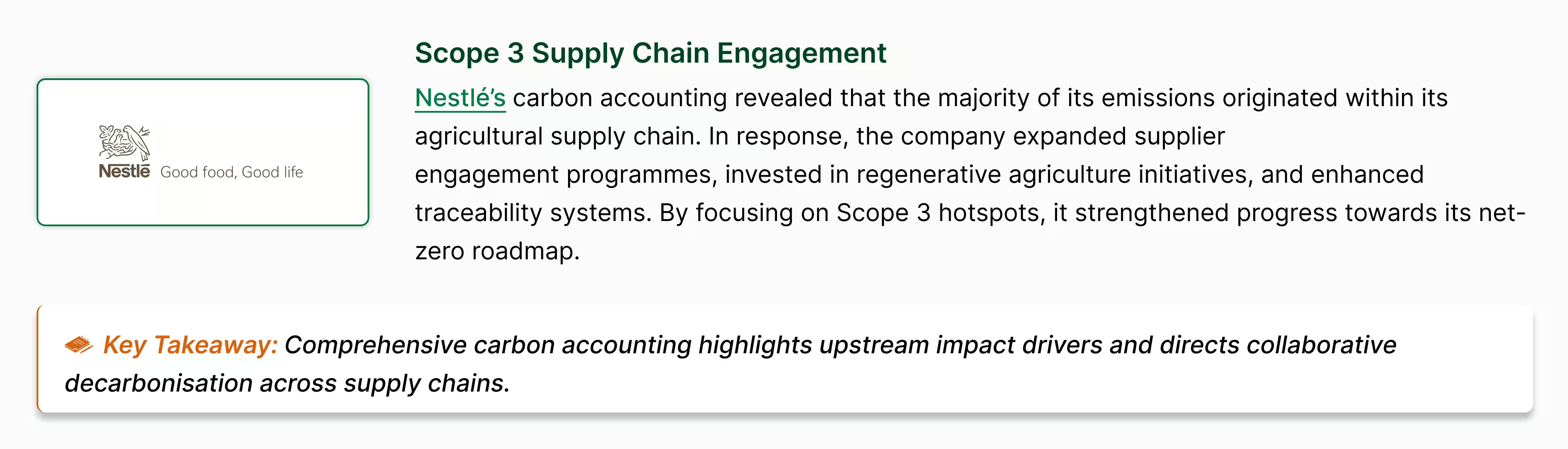
Real-world implementation demonstrates how structured carbon accounting translates ambition into measurable decarbonisation outcomes. The following examples show how businesses have embedded emissions measurement into strategic decision-making.

Tools and Resources for Carbon Accounting and Net-Zero Transition
A robust net-zero strategy requires more than emissions measurement - it depends on the effective use of specialised tools, globally recognised standards, and structured benchmarking approaches. Together, these enable organisations to move from fragmented data collection to consistent, decision-ready insights that can drive measurable decarbonisation.
Carbon Accounting Software Platforms
Digital carbon accounting platforms are critical for scaling emissions measurement across complex organisations. They automate data collection, standardise calculations, and enable reporting aligned with global frameworks. However, their true value lies in how effectively they integrate emissions data into operational and strategic decision-making.
KarbonWise
KarbonWise is designed to bridge the gap between carbon accounting and business decision-making. Beyond generating Scope 1, 2, and 3 inventories, the platform enables organisations to analyse emissions at a granular level - across products, suppliers, and operational units. This allows businesses to move beyond compliance and identify targeted decarbonisation opportunities, such as supplier optimisation, material substitution, or process improvements.
A key strength of KarbonWise lies in its ability to integrate carbon data into broader business functions such as procurement, pricing, and R&D. This ensures that sustainability is not treated as a standalone reporting exercise but becomes embedded within core operational workflows. For organisations seeking to align emissions reduction with commercial outcomes, this level of integration is critical.
Persefoni
Persefoni is widely recognised for its focus on enterprise-grade carbon accounting and climate disclosure. The platform is particularly suited for organisations navigating complex regulatory environments, where auditability and compliance are key priorities.
It provides structured workflows for data collection, automated emissions calculations aligned with the Greenhouse Gas Protocol, and reporting capabilities that support frameworks such as TCFD and ISSB. Persefoni’s strength lies in its ability to bring financial-grade rigour to carbon data, making it especially relevant for organisations where climate disclosures are closely scrutinised by investors and regulators.
Sphera
Sphera offers a comprehensive suite of sustainability and risk management solutions, with carbon accounting as a core component. It is particularly well-suited for industrial and manufacturing organisations that require detailed lifecycle analysis and integration with environmental, health, and safety systems.
The platform enables organisations to manage emissions at a highly granular level, including product-level carbon footprints and lifecycle impacts. This makes it valuable for companies looking to embed sustainability into product design and regulatory compliance, especially in sectors facing increasing pressure around product transparency and environmental performance.
Reporting Frameworks and Standards
While software platforms enable data collection and analysis, reporting frameworks ensure that emissions data is credible, consistent, and comparable across organisations and markets. Each framework serves a distinct role within the broader carbon accounting ecosystem.
Greenhouse Gas Protocol
The Greenhouse Gas Protocol forms the foundation of carbon accounting globally. It provides the methodological guidance required to measure emissions across Scope 1, 2, and 3 categories, define organisational boundaries, and ensure consistency in reporting.
Most carbon accounting platforms and regulatory frameworks are built on the principles established by the GHG Protocol. As a result, alignment with this standard is essential for ensuring that emissions data is both credible and comparable across industries.
Science Based Targets initiative
The Science Based Targets initiative focuses on translating emissions data into actionable reduction pathways. It provides guidance on setting targets that are aligned with global climate goals, ensuring that organisational commitments are grounded in climate science rather than arbitrary benchmarks.
SBTi validation has increasingly become a signal of credibility, demonstrating that an organisation’s decarbonisation strategy is aligned with recognised global standards. It also helps organisations define clear, time-bound pathways for reducing emissions across both operations and value chains.
Task Force on Climate-related Financial Disclosures
The TCFD framework shifts the focus from emissions measurement to climate-related financial risk and opportunity. It requires organisations to disclose how climate change impacts governance, strategy, risk management, and financial performance.
By linking carbon data with financial outcomes, TCFD plays a critical role in integrating sustainability into core business decision-making. It is particularly relevant for organisations facing investor scrutiny or operating in jurisdictions where climate disclosures are becoming mandatory.
Conclusion
Carbon accounting is the operational backbone of any credible net-zero emissions strategy. It converts climate ambition into measurable data, establishes a defensible baseline, and guides reduction efforts across Scope 1, 2, and 3 emissions. Without structured greenhouse gas accounting, net-zero targets remain aspirational rather than actionable.
For organisations serious about long-term decarbonisation, the first step is measurement. Building a verified emissions inventory enables informed target setting, focused reduction strategies, and transparent reporting. If your business is ready to move from commitment to execution, request a demo to explore how structured carbon accounting can accelerate your net-zero transition.
{{cta}}
{{accordion}}
{{sources}}




Continue Reading

SBTi FLAG Guidance v1.2: What Changed and What to Do Next
Learn what's new in SBTi FLAG Guidance v1.2, including updated deadlines, mandatory commodities, no-deforestation requirements, and practical steps for businesses.

.png)


.avif)








.svg)
.svg)