Understanding Secondary Data in Life Cycle Assessment (LCA): Role, Challenges, and Best Practices
Learn how secondary data is used in Life Cycle Assessment (LCA), its benefits, limitations, and best practices for improving sustainability reporting and carbon footprint accuracy.
.avif)

.svg)
Table of Contents


Introduction to Data in Life Cycle Assessment
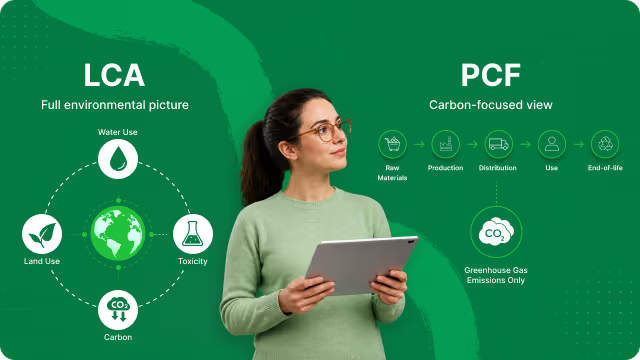
Life Cycle Assessment, or LCA, is a structured methodology used to evaluate the environmental impacts of a product, service or system across its entire life cycle. This spans raw material extraction, manufacturing, distribution, use and end-of-life treatment. The purpose is to understand total impact rather than focusing on a single stage in isolation.
The framework is defined under ISO 14040 and ISO 14044, issued by the International Organization for Standardization. These standards set requirements for defining system boundaries, collecting Life Cycle Inventory data, assessing impacts and interpreting results. At every stage, the quality of the outcome depends on the quality of the data.
A key distinction in LCA is between primary and secondary data. Primary data is collected directly from specific operations, such as metered energy use or production records from a facility. It reflects actual performance. Secondary data is sourced from databases, academic research, industry averages or government emission factors. It represents typical conditions rather than site-specific measurements.
Most LCAs use a combination of both. Primary data is generally preferred for processes under direct control, while secondary data is often used for background systems such as electricity generation or raw material production.
Data quality is critical. ISO methodology requires assessment of geographic relevance, technological representativeness, temporal coverage and reliability. Using outdated or regionally mismatched datasets can materially distort results. As sustainability reporting faces increasing regulatory and investor scrutiny, organisations must justify their data choices and clearly document assumptions. Transparency is now central to credible environmental claims.
Understanding Secondary Data in LCA
Secondary data in Life Cycle Assessment refers to information that has not been directly measured for the specific product system being analysed. Instead, it is sourced from existing research, structured databases, government statistics or industry averages. It is primarily used to model processes where site-specific primary data is unavailable or impractical to collect.
Common sources include established LCA databases such as Ecoinvent and GaBi, which provide Life Cycle Inventory datasets covering materials, fuels, electricity systems, transport and waste treatment. Government emission factor libraries are also widely used, including datasets published by the UK Department for Environment, Food & Rural Affairs and the U.S. Environmental Protection Agency. These resources consolidate peer-reviewed research and statistical data into structured formats compatible with LCA software.
Secondary data is commonly applied in screening LCAs, early-stage product development and complex supply chain assessments. In multi-tier global value chains, collecting primary data for every upstream activity is rarely feasible. It is also frequently used to estimate Scope 3 emissions, where organisations rely on industry averages to approximate impacts from purchased goods, transport, use phase and end-of-life treatment.
Methodological guidance under ISO 14040 and ISO 14044 promotes a data hierarchy approach. Primary data should be used for processes under direct control wherever possible, with supplier-specific data preferred over generic averages. Secondary datasets are typically applied to background systems or where access is limited. The closer the dataset reflects the actual system being assessed, the stronger and more defensible the LCA.
Pros of Using Secondary Data in LCA
.avif)
Secondary data remains central to most Life Cycle Assessments because it makes comprehensive modelling possible within realistic constraints. When selected carefully, it enables structured analysis without excessive delay or cost.
- Cost and Time Efficiency: Secondary datasets allow practitioners to build Life Cycle Inventory models without waiting for supplier engagement, site visits or internal data collection cycles. This significantly reduces project timelines, particularly in screening LCAs or early-stage product evaluations. It also lowers the financial burden associated with data verification and coordination across multiple facilities or regions.
- Accessibility and Availability: Established LCA databases provide extensive datasets covering materials, fuels, electricity systems, transport and waste treatment processes. This accessibility enables organisations to model complex product systems even when direct access to upstream suppliers is limited. In early-stage assessments, secondary data supports rapid comparison of design alternatives and identification of high-impact stages.
- Standardisation and Benchmarking: Recognised databases apply harmonised system boundaries, allocation rules and modelling assumptions. This consistency reduces methodological variation between studies and supports comparability. When organisations rely on similar background datasets, benchmarking across products or sectors becomes more meaningful and defensible.
- Practical for Scope 3 and Complex Supply Chains: Scope 3 emissions often represent the largest share of a product’s environmental footprint, yet they occur outside direct operational control. Secondary data enables estimation of upstream raw material extraction, transport, use-phase energy consumption and end-of-life treatment. It fills unavoidable data gaps and allows organisations to construct a complete life cycle model despite limited visibility across multi-tier supply chains.
Cons of Using Secondary Data in LCA
.avif)
While secondary data enables practical modelling, it introduces structural limitations that can materially affect the reliability of an LCA. These constraints become more significant as studies move from screening exercises to decision-critical or public-facing assessments.
- Reduced Accuracy and Representativenes: Secondary datasets are typically based on generic industry averages rather than specific facilities or suppliers. They may not reflect actual production technologies, energy sources or operational efficiencies. This lack of site-specific detail can lead to results that diverge from real-world performance. In comparative studies or public disclosures, even small representational gaps can influence outcomes.
- Data Age and Obsolescence: Many secondary datasets rely on historical data. In sectors experiencing rapid change, particularly electricity generation, steel, cement or transport fuels, outdated emission factors can distort results. Energy mixes are evolving and technologies are improving. If datasets are not regularly updated, they may overestimate or underestimate impacts, weakening the credibility of the assessment.
- Transparency and Documentation Issues: Not all secondary data sources provide full clarity regarding assumptions, allocation rules or system boundaries. Limited visibility into how a dataset was constructed makes it difficult to assess uncertainty or defend modelling choices during review. Inconsistent methodological approaches across databases can also introduce hidden variation within a study.
- Risk of Misleading Conclusions: When secondary data dominates a model, there is a risk of drawing conclusions based on non-specific inputs. Environmental hotspots may appear more or less significant depending on the dataset selected. This can result in over- or under-estimation of impacts and, in turn, influence strategic decisions in ways that are not fully aligned with actual operational performance.
When to Use Secondary Data vs Primary Data
Choosing between secondary and primary data is not a technical preference. It is a strategic decision shaped by the purpose of the study, the level of risk attached to the results and regulatory expectations. ISO methodology promotes a data hierarchy principle: prioritise primary data for processes under direct control, use supplier-specific data where feasible and rely on secondary datasets where access is limited or the process sits in the background system.
In practice, most LCAs apply a combination of both. The question is not which data type is “better”, but which is appropriate for the objective of the assessment, whether that is internal screening, product comparison, public disclosure or regulatory compliance.
.avif)
A disciplined approach involves identifying which life cycle stages drive the majority of impacts and prioritising primary data collection accordingly. Secondary data should be selected based on relevance, recency and methodological consistency. Over time, organisations can strengthen credibility by progressively replacing high-impact generic datasets with supplier-specific information.
This balance ensures that LCA remains both practical and defensible.
Best Practices for Improving Secondary Data Reliability
Secondary data will remain a core component of most LCAs, particularly for background systems and complex supply chains. The objective is not to eliminate it, but to manage it with discipline. Reliability improves when organisations apply structured selection criteria, maintain updates and strengthen transparency over time.
The first priority is selecting high-quality databases. Not all datasets are equal in methodological rigour or transparency. Credible databases typically document system boundaries, allocation methods, geographic coverage and the year of data collection. They align with recognised standards such as ISO 14040 and ISO 14044 and undergo periodic review. When choosing between datasets, practitioners should assess technological representativeness, regional relevance and temporal validity. A geographically aligned dataset that reflects current production technology is generally more defensible than a broad global average.
Regular data updates are equally important. Emission factors and background systems evolve, particularly in sectors undergoing rapid decarbonisation. Electricity grids change, fuel mixes shift and industrial processes improve in efficiency. Organisations conducting recurring LCAs should monitor database revisions and reassess material assumptions when new versions are released. Periodic recalculation ensures that reported results reflect current conditions rather than historical averages.
Transparent documentation strengthens credibility. Every secondary dataset used in a study should be clearly identified, including its source, version, geographic scope and reference year. Assumptions regarding allocation, cut-off criteria or data modifications should be explicitly stated. Reporting data quality indicators such as representativeness and completeness enables reviewers to understand the level of uncertainty involved. Transparency does not remove uncertainty, but it makes it visible and manageable.
Finally, reliability improves when secondary data is treated as a transitional tool rather than a permanent substitute for primary information. Where high-impact processes are identified, organisations should prioritise supplier engagement and structured data collection. This may involve requesting energy and material consumption data, incorporating disclosure requirements into procurement contracts or implementing internal monitoring systems. Over time, replacing generic averages with site-specific inputs strengthens both accuracy and defensibility.
A disciplined approach to database selection, updating, documentation and progressive primary data integration ensures that secondary data supports informed decision-making rather than undermining it.
Case Examples: Balancing Secondary and Primary Data in Practice
In real-world LCAs, organisations rarely begin with complete primary datasets. Studies typically start with secondary data to build an initial footprint and identify environmental hotspots. As supplier engagement improves and data systems mature, companies gradually replace generic datasets with primary information, improving both accuracy and credibility.
.avif)
Apple: Product carbon footprint refinement
Apple has publicly reported product carbon footprints for several devices, including iPhones, MacBooks and Apple Watches. Early modelling of these products relied on secondary datasets for upstream materials such as aluminium, glass and semiconductor components. This allowed the company to estimate impacts across complex global supply chains where direct supplier data was initially limited.
Over time, Apple began collecting primary emissions and energy data from key manufacturing partners through its supplier responsibility programmes. Suppliers now report energy use, renewable electricity adoption and process emissions. Incorporating this primary data has allowed Apple to refine upstream emissions estimates and publish more detailed product environmental reports, improving transparency and credibility.
Volkswagen: Battery supply chain data
The automotive industry increasingly relies on detailed LCAs to understand the environmental footprint of electric vehicles. Volkswagen initially used secondary datasets for battery materials such as lithium, nickel and cobalt when modelling early electric vehicle designs. These averages helped estimate the carbon intensity of battery production during early development stages.
As electric vehicle production scaled, Volkswagen began working directly with battery suppliers to obtain primary data on cell manufacturing energy use and material processing. This transition enabled more precise modelling of battery-related emissions and helped identify opportunities to reduce impacts through renewable electricity sourcing and improved manufacturing efficiency.
Nestlé: Agricultural supply chain data
In the food sector, agricultural emissions are often estimated using secondary emission factors for fertiliser use, crop cultivation and livestock management. Nestlé initially relied on such datasets to assess the footprint of raw materials across its global supply chains.
The company has since expanded programmes that collect primary farm-level data through supplier engagement initiatives. Farmers participating in these programmes provide information on fertiliser use, energy consumption and land management practices. Integrating this primary data has allowed Nestlé to improve the accuracy of agricultural footprint assessments and better track emissions reductions across its supply network.
These examples illustrate a common progression in LCA practice. Secondary data enables organisations to model complex systems quickly, while gradual integration of supplier-specific primary data strengthens accuracy, supports better decision-making and improves the credibility of sustainability reporting.
Tools and Resources for Managing LCA Data Effectively
Managing Life Cycle Assessment data requires more than individual datasets. Effective LCA practice depends on a combination of software platforms, structured databases and methodological frameworks that ensure consistency and reliability across studies.
LCA software platforms are typically the starting point for structured modelling. Tools such as GaBi, SimaPro and OpenLCA allow practitioners to build full life cycle models, integrate background datasets and run impact assessments across different environmental indicators. These platforms provide structured workflows for inventory development, scenario comparison and interpretation. They also enable practitioners to combine primary operational data with secondary background datasets, which is essential when modelling complex product systems.
Environmental databases and emission factor libraries provide the background datasets that support most LCAs. These resources contain Life Cycle Inventory data for materials, fuels, electricity generation, transport and waste treatment processes. Well-known databases such as Ecoinvent compile peer-reviewed datasets that can be directly integrated into LCA software. Government emission factor libraries also play an important role in carbon accounting, particularly for energy use, fuel combustion and transport activities. These sources help practitioners estimate impacts where direct measurements are unavailable.
Data quality assessment frameworks help evaluate whether selected datasets are appropriate for a given study. ISO-based LCA practice emphasises criteria such as geographic representativeness, technological alignment, temporal relevance and completeness. Applying structured quality indicators helps practitioners identify potential uncertainty within datasets and justify modelling choices during review or verification. This process is particularly important when secondary data is used extensively.
Industry best-practice guidelines provide methodological direction for conducting and reporting LCAs. Standards such as ISO 14040 and ISO 14044 define the overall structure of LCA studies, including requirements for data quality, system boundaries and interpretation. Sector-specific guidance documents and product category rules further refine these requirements for particular industries. Together, these tools and frameworks ensure that LCA data is applied consistently, transparently and in line with recognised methodological standards.
Conclusion
Secondary data plays a critical role in making Life Cycle Assessments practical. It allows organisations to model complex product systems, estimate impacts across supply chains and conduct early-stage environmental assessments without extensive data collection. Its advantages lie in accessibility, speed and the ability to fill unavoidable gaps where primary information is not available.
However, secondary data also has clear limitations. Generic industry averages may not reflect actual operational conditions, datasets can become outdated and limited transparency around assumptions can introduce uncertainty. When used without careful evaluation, these factors can affect the reliability of LCA results and the decisions based on them.
This is why strategic data selection is essential. Organisations should prioritise primary data for processes that significantly influence environmental impacts while using high-quality secondary datasets for background systems. Applying clear data hierarchy principles, monitoring dataset updates and documenting assumptions can significantly strengthen the credibility of an assessment.
Over time, improving data maturity should become a priority. Engaging suppliers, building internal data collection systems and gradually replacing generic datasets with site-specific information allows organisations to refine their models and make more confident sustainability decisions.
If your organisation is looking to streamline LCA workflows, improve data management and strengthen carbon footprint analysis, request a demo to see how structured tools can support more accurate and scalable sustainability assessments.
{{cta}}
{{accordion}}
{{sources}}

Continue Reading
.avif)
Top 5 LCA Software Tools in 2026
Explore the top LCA software tools of 2026 and compare their features, strengths, and use cases for lifecycle assessment, carbon footprinting, and sustainability reporting.

LEED v5, Embodied Carbon, and the Whole-Lifecycle Mandate: What Project Developers and Asset Owners Need to Know
LEED v5 introduces a whole-life carbon approach to building certification, making embodied carbon assessment a key requirement for project developers, asset owners, designers, and investors.


.avif)








.svg)
.svg)