TCFD: A Framework Helping Businesses Look Further Than the Next Quarter
TCFD helps organisations integrate climate risk into financial and strategic decision-making, strengthening resilience, transparency and long-term business planning.

.svg)
Table of Contents


Climate change has moved from the background of corporate strategy to the very centre of financial and operational planning. Supply chain volatility, shifting regulations, changing customer expectations, and rising transition costs all influence how organisations allocate capital and assess risk. The Task Force on Climate-related Financial Disclosures (TCFD) reshaped this landscape by placing climate impacts inside financial decision-making rather than limiting them to sustainability chapters.
At its core, TCFD helps organisations think in terms of resilience. How might different climate outcomes influence margins, pricing, or product demand? What happens when new regulations tighten across several regions at once? How resilient is an organisation’s supply chain under climate stress? Instead of offering prescriptive rules, TCFD offers a strategic lens that encourages long-term thinking over short-term reaction.
How TCFD Became the Global Benchmark
The framework emerged when the Financial Stability Board released a set of recommendations, now fully detailed in the official TCFD guidance. The goal was to help global markets price climate risk more accurately. What followed was a widespread uptake that surpassed initial expectations. By 2024, a large majority of major global companies were disclosing information aligned with at least one of the TCFD recommendations, showing how widely the framework has been adopted.
Investors have accelerated this shift. Many institutional investors now integrate climate risk into investment decision-making, treating weak or inconsistent disclosures as indicators of unmanaged risk rather than neutral omissions.
Government policy reinforced this momentum. The UK became the first G20 nation to mandate climate disclosures for listed and large private companies through the government’s climate reporting rules. This shift signalled that climate risk is no longer an optional reporting area but a regulatory expectation.
Market research strengthened the case. A 2024 OECD analysis found that companies with stronger climate disclosures often benefit from lower capital costs. Transparency signals maturity and reduces perceived risk, both of which improve investor confidence.
Together, these forces turned TCFD into a global baseline for credible climate strategy.
Understanding What TCFD Asks of Businesses
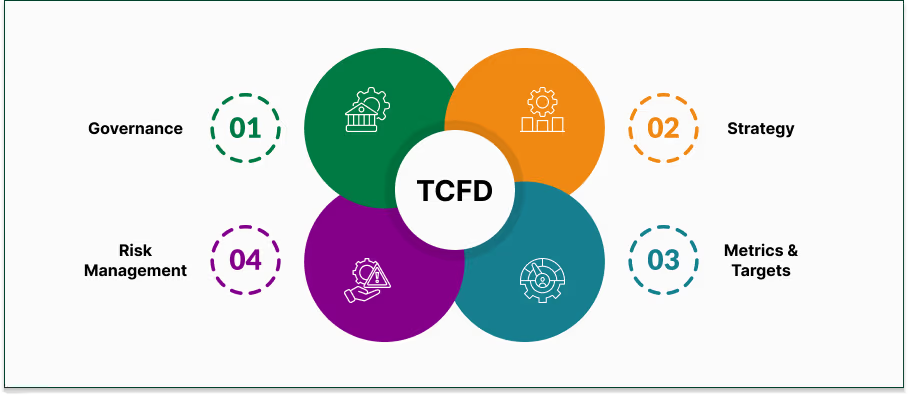
TCFD covers four pillars: governance, strategy, risk management, and metrics and targets. Rather than focusing solely on carbon accounting, it asks organisations to understand how climate-related factors influence financial health.
Governance expectations clarify who is responsible for climate oversight. Strategy requirements explore how climate changes reshape markets, supply chains, and product portfolios. Risk management integrates climate considerations into enterprise risk systems. Metrics and targets define how progress is tracked, with Scope 1, 2, and 3 emissions forming the foundation. Value-chain emissions remain critical, guided by the GHG Protocol’s Scope 3 framework.
Scenario analysis sits at the heart of TCFD. Organisations are encouraged to test their resilience across different climate futures, drawing on scientific pathways such as those presented in the IPCC’s Sixth Assessment scenarios. These scenarios help companies model how policy tightening, market shifts, or physical climate impacts may reshape long-term strategy.
Supply chain transparency is now considered essential for responsible sourcing.
Signals That Strengthen TCFD Reporting
TCFD becomes transformative when organisations move from descriptive reporting to strategic alignment. Five areas influence the maturity of disclosures:
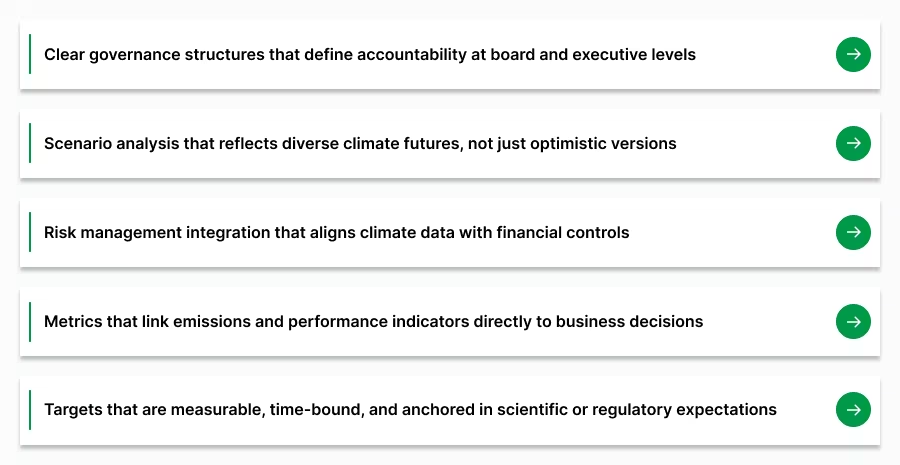
These elements help organisations move beyond compliance into genuine preparedness.
Climate Preparedness Through a Practical Lens
Climate change affects different organisations in different ways. Some face physical risks such as flooding, heat stress, or water scarcity. Others face transition risks like carbon pricing, regulatory shifts, and evolving customer expectations. TCFD helps organisations interpret these pressures through a financial lens.
In the UK, this is already evident. Businesses face weather-related disruptions, insurance changes, and rising expectations for transparency. TCFD helps organisations articulate how their strategy holds up under pressure. It also complements life cycle thinking by drawing attention to how materials, manufacturing routes, and transport patterns influence climate exposure.
Life cycle perspectives enrich TCFD because many climate-related risks originate far upstream. Material choices may create vulnerabilities due to future carbon taxes. Manufacturing processes may rely on regions with tightening environmental policies. End-of-life expectations may shift consumer preference. When teams use LCA-informed insights alongside TCFD, their risk assessments become far more accurate.
Scenario planning also challenges assumptions. What if lower-carbon alternatives disrupt existing markets faster than expected? What if insurance premiums increase across specific regions? What if customers begin favouring low-impact products even where regulation is weak? By bringing these questions into mainstream planning, TCFD encourages organisations to build strategies that can withstand multiple futures.
Capabilities That Build Long-Term Resilience
Climate resilience depends on a combination of strategic clarity, operational insight, and long-term vision. These capabilities support organisations navigating increasingly complex climate pressures.
{{flipcards}}
A New Look at TCFD in Business Reality
In practice, TCFD transforms internal operations far more than many organisations expect. Finance teams begin working closely with sustainability teams to align data. Risk managers recognise the importance of emissions visibility and supply-chain transparency. Product teams turn to LCA insights to understand how materials, components, and manufacturing choices shape both emissions and climate exposure. This leads to more integrated decision-making, grounded in evidence rather than intuition.
Companies often uncover gaps in supplier capability or data completeness. They may discover that certain product lines are far more sensitive to future regulations than others. Some may realise their assumptions about customer expectations are outdated. TCFD does not eliminate uncertainty, but it gives organisations the tools to navigate uncertainty with confidence.
Furthermore, strong disclosures enhance credibility with customers, investors, and regulators. Buyers prefer suppliers that can articulate climate exposure clearly. Investors are more confident in organisations that understand risk. Regulators respond more favourably to companies that prepare early rather than react late.
What TCFD provides is coherence. The framework helps organisations assemble climate, financial, and operational data into a narrative that supports long-term planning.
The Climate Intelligence Behind Competitive Advantage
The organisations that excel in climate preparedness often share certain traits:
- they think beyond compliance
- they connect product decisions to long-term exposure
- they anticipate regulations rather than respond to them
- they use data as a foundation for credible action
In this sense, TCFD is more than a reporting framework. It is a competitive strategy. It helps organisations understand where risk accumulates, where opportunities sit, and where efficiency gains may emerge. When combined with LCA insights, TCFD becomes even more powerful because it connects climate risk to material flows, product dependencies, and value-chain design.
This forward-looking mindset aligns closely with how UK organisations approach strategic planning: measured, evidence-based, and grounded in long-term stability.
Case Studies: How Organisations Use TCFD to Strengthen Strategy
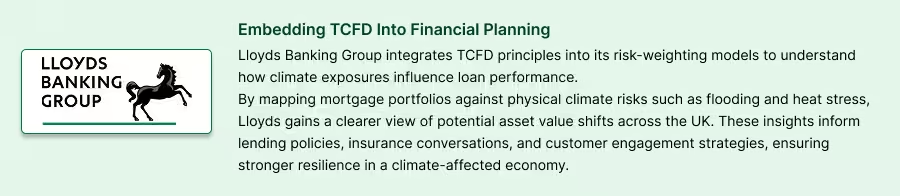
TCFD can feel theoretical until you see how it changes decision-making inside real organisations. These examples show how the same framework supports resilience, investment clarity, and long-term competitiveness across very different sectors.
Where KarbonWise Fits
KarbonWise supports TCFD-aligned reporting by integrating climate, carbon, and operational data into a central ESG data spine. The platform supports Scope 1-3 accounting, building and product LCA, and mapping to frameworks such as GRI, SRS, CSRD, BRSR, and EcoVadis. By bringing risk indicators, emissions metrics, and scenario-aligned insights together, KarbonWise helps teams produce confident, consistent, audit-ready climate disclosures.
{{cta}}
{{accordion}}
{{sources}}

.avif)
.avif)
.avif)
Continue Reading
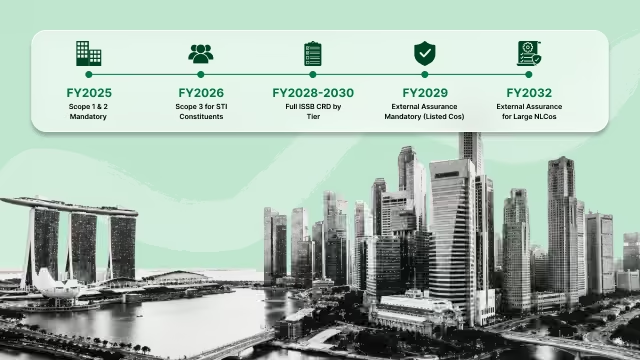
ACRA's 3-Tier Climate Reporting Rules: Deadlines, Disclosures, and What to Do No
Singapore's framework is climate-first by design. Under ACRA's proposed Sustainability Disclosure Standards, SFRS S2 (climate disclosures) would be mandatory. SFRS S1 (broader sustainability disclosures covering biodiversity, human capital, and social impact) would remain voluntary for now. This narrows the immediate reporting scope while keeping GHG emissions data mandatory


.avif)







.svg)
.svg)