What Is Life Cycle Assessment (LCA) and How Does It Work? A Practical Guide for Businesses
Life cycle assessment (LCA) helps businesses measure environmental impacts across the full product life cycle. This guide explains how LCA works, why it matters for ESG and Net Zero, and how organisations apply it at scale to improve design, procurement, and sustainability decisions.

%20(1).svg)
Table of Contents


Life cycle assessment, commonly known as LCA, has moved from the margins of environmental research into the centre of business decision-making. As organisations face growing pressure to reduce environmental impacts, improve product transparency, and support ESG and Net Zero commitments, LCA offers a structured way to understand where impacts truly occur across a product’s life cycle.
Yet despite its growing relevance, LCA is often misunderstood. Many explanations remain academic, focusing on theory rather than how organisations can apply LCA in real commercial settings. This guide takes a practical, business-focused view, explaining what life cycle assessment is, how it works, and how companies can use it at scale to make better product and sustainability decisions.
What is Life Cycle Assessment (LCA)?
Life cycle assessment is a method used to evaluate the environmental impacts of a product or service across its entire life cycle, from raw material extraction through manufacturing, use, and end-of-life treatment. Rather than focusing on a single stage, LCA brings all stages together into one system view, helping organisations avoid shifting impacts from one part of the value chain to another.
At its core, LCA answers a critical question for businesses: where do the most significant environmental impacts actually occur?
By quantifying emissions, resource use, and other indicators across the full product life cycle, companies gain a clearer, evidence-based understanding of their environmental footprint.
Life cycle assessment is formally defined under ISO 14040 and ISO 14044, which establish the principles, framework, and requirements for assessing environmental impacts across a product’s full life cycle.
Why Life Cycle Assessment is Important for Businesses
For businesses, LCA goes far beyond environmental reporting. It supports informed decisions across product design, sourcing, procurement, and long-term strategy. As sustainability expectations rise among customers, investors, and regulators, organisations are increasingly expected to demonstrate credible evidence rather than broad commitments.
The European Commission’s Joint Research Centre positions life cycle assessment as a foundation for consistent environmental decision-making across industries, reinforcing its growing role in both regulation and business practice.
This alignment between policy and market expectations means LCA is no longer a niche exercise. For many sectors, it is becoming a core capability that underpins competitiveness, risk management, and credible environmental claims.
How Life Cycle Assessment Works
Life cycle assessment sits at the heart of modern sustainability analysis, providing a structured way to understand how products and services interact with the environment. As organisations face growing pressure to substantiate environmental claims, LCA offers a recognised approach for moving beyond assumptions and focusing on measurable impacts across the full value chain.
The Four Stages of LCA Explained
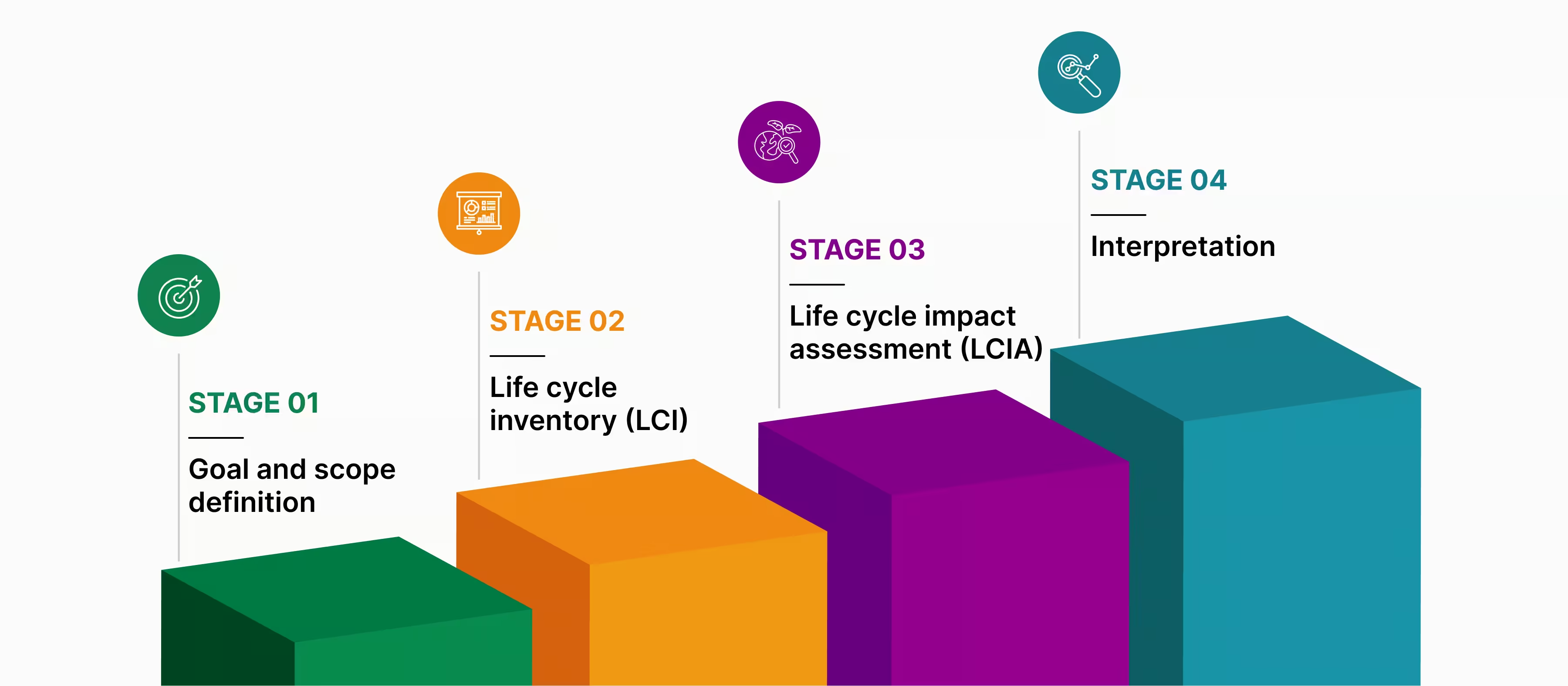
Life cycle assessment follows a structured four-stage process designed to ensure robustness and comparability.
- Goal and scope definition - Defines the purpose of the assessment, the product system, functional unit, system boundaries, and assumptions
- Life cycle inventory (LCI) - Collects data on energy use, materials, emissions, and waste across the life cycle
- Life cycle impact assessment (LCIA) - Translates inventory data into environmental impact indicators
- Interpretation - Analyses results to identify hotspots and support decisions
Cradle-to-Grave vs Cradle-to-Gate Analysis
A key part of how life cycle assessment works in practice is defining which stages of the life cycle are included. This choice directly affects both the results and how they can be used.
A cradle-to-grave assessment captures impacts from raw material extraction through manufacturing, use, and end-of-life treatment. It is typically used when the objective is to understand full product impacts, compare alternative designs, or support external disclosure.
A cradle-to-gate assessment focuses on upstream stages only, ending at the factory gate. This approach is often applied for supplier comparisons, material selection, or situations where downstream use and disposal are outside the organisation’s control.
Selecting the appropriate boundary ensures the assessment remains aligned with its intended purpose and avoids drawing conclusions that the data cannot support.
Data Collection and Impact Calculation Methods
Once the process and system boundaries are defined, life cycle assessment relies on consistent data collection and calculation methods to convert activity data into environmental impacts.
Businesses typically use a combination of primary data, such as operational energy use or material inputs, and secondary datasets from recognised databases to fill gaps where direct measurement is not feasible. Emission factors and impact characterisation models are then applied to ensure results are calculated consistently.
Balancing data accuracy, coverage, and practicality is a core part of how LCA works at scale, particularly across complex and global supply chains. Clear documentation of data sources and assumptions helps maintain transparency and supports confidence in the final results.
How Businesses Apply LCA
For most organisations, the challenge with life cycle assessment is not understanding the methodology, but applying it consistently across multiple products, projects, or regions. At scale, LCA becomes a structured operational process rather than a one-off study.
Businesses typically begin by defining a common set of system boundaries, functional units, and assumptions that can be reused across assessments. This creates a baseline that allows results to be compared across products or projects. Once this structure is in place, data collection becomes more efficient, as teams are no longer starting from scratch with each new assessment.
In manufacturing, LCA is often rolled out across product portfolios. A representative product is modelled first, capturing key materials, processes, and energy sources. Variants are then created to assess alternative materials, suppliers, or production methods. This approach enables faster comparisons and helps teams identify environmental hotspots that offer the greatest opportunity for improvement.
For FMCG companies, scale is driven by speed and volume. Products are grouped by category, with shared templates used for common ingredients, packaging formats, and logistics routes. LCA results are used to guide packaging redesign, supplier selection, and substantiation of sustainability claims, even as formulations and product ranges change frequently.
In construction and the built environment, LCA is applied at the project level but must still operate consistently across multiple developments. Assessments are structured around building elements such as substructure, superstructure, finishes, and services. Early-stage LCAs support design decisions, while later assessments are used for compliance, reporting, and certification. Standardised assumptions allow developers to track embodied carbon performance across portfolios, not just individual buildings.
Across sectors, the most effective organisations treat LCA as an iterative process. Models are updated as designs evolve, data improves, and supply chains change. This allows life cycle assessment to inform real decisions throughout the product or project lifecycle, rather than being confined to a final report.
Life Cycle Assessment in Practice: Industry Use Cases at Scale
Manufacturing: Portfolio-Level Decisions
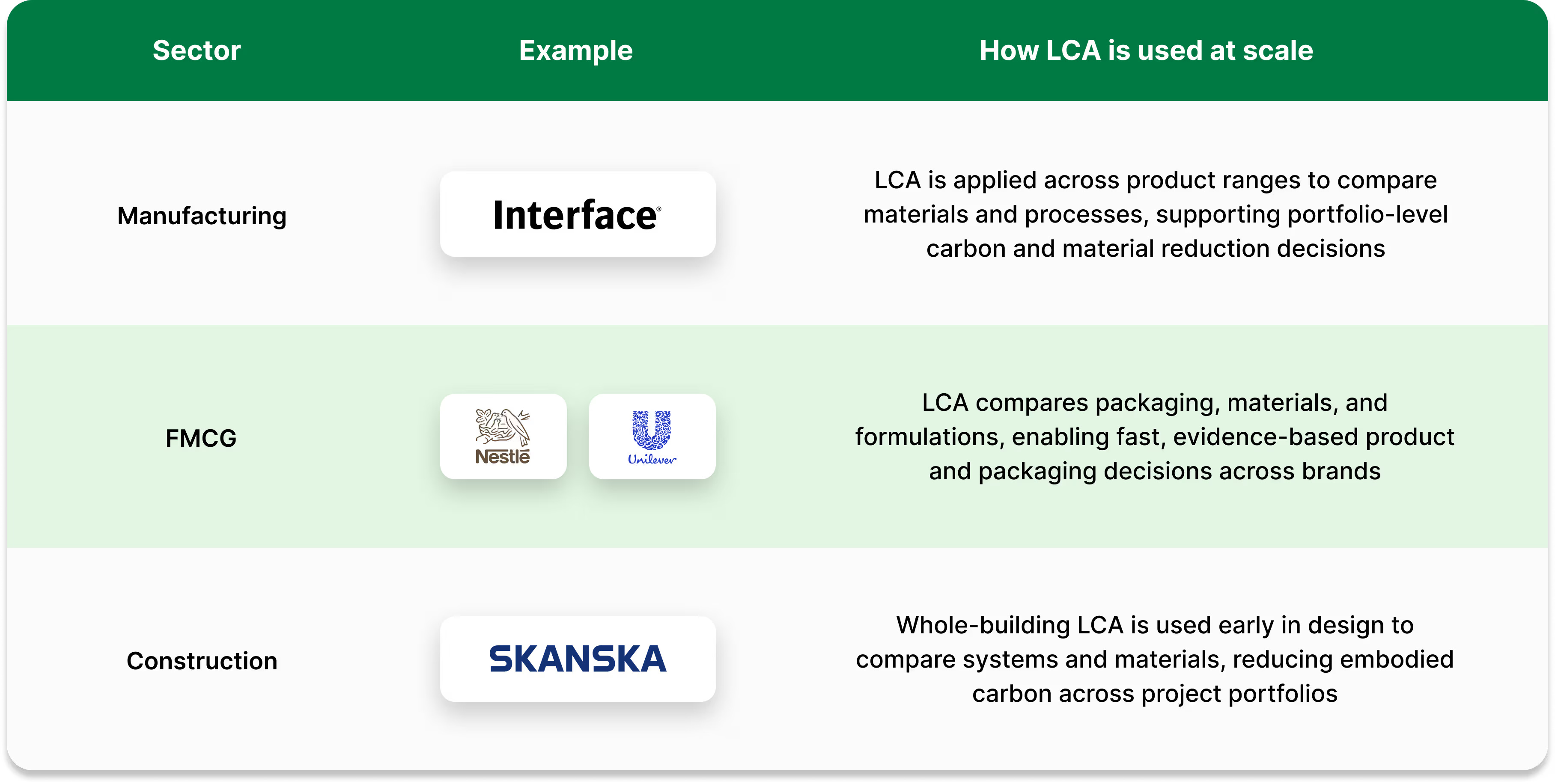
Interface is an example of a manufacturer that has applied life cycle assessment across entire product ranges rather than single products. The company has publicly described how LCA is used to compare materials, backing systems, and manufacturing processes, enabling portfolio-level decisions that reduce lifecycle carbon and material impacts. This approach allows product teams to test alternatives early and prioritise changes that deliver the greatest environmental improvement across multiple product lines.
FMCG: Packaging and Product Comparisons at Speed
Unilever has described the use of life cycle assessment and lifecycle thinking to inform product and packaging decisions across its brands. LCA is applied to compare packaging formats, material choices, and formulation options, helping teams balance environmental impact with performance and commercial constraints. In a high-volume FMCG context, this enables sustainability considerations to be integrated into fast-moving product development cycles.
Nestlé provides an example of how life cycle assessment is applied at product level, particularly within food and beverage categories. LCA is used to assess agricultural sourcing, processing, packaging, and end-of-life impacts, supporting decisions on reformulation and packaging across large, complex supply chains where incremental changes can have cumulative effects.
Construction and the Built Environment: Design-Stage Impact Reduction
In the construction sector, Skanska is a frontrunner in applying whole-building life cycle assessment to assess and reduce embodied carbon across projects. LCA is used early in design to compare structural systems, materials, and construction methods, when changes are still feasible and cost-effective. By standardising approaches across projects, developers can track embodied carbon performance at portfolio level rather than treating each building as a standalone case.
What these Examples Demonstrate
Across manufacturing, FMCG, and construction, these organisations use life cycle assessment not as a reporting exercise, but as a decision-support tool. LCA enables comparison between options, visibility of trade-offs, and repeatable analysis at scale. This is what allows businesses to move beyond theory and apply life cycle assessment in ways that influence real product, packaging, and design decisions.
Life Cycle Assessment Standards and Frameworks
Life cycle assessment does not exist in isolation. Its credibility and usefulness depend on clearly defined standards and frameworks that guide how studies are conducted and interpreted. These frameworks provide the structure that allows LCA results to be trusted, compared, and used confidently in business decision-making, reporting, and regulatory contexts.
ISO-Based LCA Frameworks Explained
International standards define how LCA studies should be structured, documented, reviewed, and reported, ensuring transparency and methodological consistency. In practice, these standards act as a shared rulebook that allows organisations to carry out assessments in a way that is comparable, defensible, and repeatable across products, projects, and regions.
For businesses, this structure is critical. Without a standardised framework, LCA results risk being influenced by inconsistent boundaries, selective assumptions, or incomplete data. Standards help ensure that assessments follow a clear sequence, from defining the purpose of the study through to interpreting results, while requiring documentation of assumptions, data sources, and limitations. This level of discipline becomes especially important when LCA outputs are used beyond internal decision-making, such as in customer communication, certification processes, or regulatory submissions.
ISO-based frameworks also support internal alignment. When sustainability, product, and procurement teams work from the same methodological foundation, it becomes easier to compare results across product lines and track improvement over time rather than treating each assessment as a standalone exercise.
LCA in Product Carbon Footprinting
Life cycle assessment underpins product carbon footprinting by providing a consistent framework for calculating greenhouse gas emissions across life cycle stages. Rather than focusing only on operational emissions, LCA enables organisations to capture upstream and downstream impacts, including raw material extraction, manufacturing, transport, use, and end-of-life treatment.
This whole-life perspective is what gives product carbon footprints their credibility. By using LCA principles, businesses can ensure that carbon calculations are based on clearly defined boundaries and functional units, reducing the risk of double counting or omission. It also allows for fair comparisons between products or design options, as emissions are assessed on a like-for-like basis.
For companies managing large product portfolios, this consistency is essential. Product carbon footprints informed by LCA can be updated, compared, and aggregated more reliably, supporting portfolio-level analysis and helping organisations identify where design or sourcing changes will have the greatest impact on emissions reduction.
Regulatory and Sustainability Reporting Alignment
LCA increasingly supports ESG disclosures, eco-design requirements, and product-level transparency expectations. As sustainability reporting frameworks evolve, there is growing emphasis on evidence-based claims and lifecycle thinking rather than isolated metrics.
Life cycle assessment helps organisations respond to this shift by providing structured data that aligns with reporting requirements related to environmental impacts, resource efficiency, and carbon performance. It also supports compliance with product-focused regulations and voluntary schemes that require an understanding of impacts beyond direct operations.
From a reporting perspective, LCA strengthens confidence in disclosures. When environmental claims are backed by structured lifecycle analysis, organisations are better positioned to withstand scrutiny from regulators, customers, and investors. Over time, this alignment between LCA and reporting frameworks helps move sustainability from a communications exercise to a core part of business governance and risk management.
Key Benefits of Life Cycle Assessment for Businesses
{{flipcards}}
Common Challenges in Life Cycle Assessment
While life cycle assessment offers valuable insight, implementing it in practice is not without difficulty. Many organisations encounter structural, data, and resource-related barriers that limit the accuracy, scalability, or usefulness of LCA studies, particularly when assessments move beyond one-off analyses and into ongoing business processes.
Data Quality and Availability Issues
Accessing consistent, high-quality data across suppliers and regions remains a significant challenge.
Complexity of Multi-Supplier Supply Chains
As product portfolios expand, manual LCA approaches struggle to keep pace with frequent updates and supplier variation.
Time and Cost Constraints in Manual LCA
The life cycle assessment software market is projected to grow rapidly in response to regulatory pressure and rising reporting demands, signalling a shift away from spreadsheet-based approaches.

How KarbonWise Simplifies Life Cycle Assessment
KarbonWise enables fast, reliable, and automated Life Cycle Assessment (LCA) across products and buildings, supporting organisations from early design through to end of life. Built on ISO 14040 and ISO 14044–compliant methodologies, KarbonWise delivers scientifically robust, transparent, and audit-ready results.
For products, KarbonWise supports cradle-to-grave LCA and Product Carbon Footprints, enabling teams to compare variants, identify hotspots, and assess material or process alternatives using a combination of primary data and leading global LCA databases. Outputs are structured to support Environmental Product Declarations (EPDs) and customer or regulatory disclosures.
For buildings, KarbonWise delivers whole-building Life Cycle Assessment (WBLCA) across all stages, enabling early-stage design comparisons, embodied and operational carbon reduction, and certification-ready outputs aligned with LEED v5, GRIHA, BREEAM, and other whole-life carbon frameworks.
By embedding LCA directly into decision-making, KarbonWise transforms it from a one-off exercise into a scalable tool for low-carbon and circular design.
Ready to apply LCA in practice?
Speak to our team to see how KarbonWise supports scalable, decision-led life cycle assessment across products and buildings. Request a demo or trial the software to explore how LCA can be embedded directly into your design, product, and sustainability workflows.

Conclusion
Over the coming years, life cycle assessment is likely to become less of a specialist sustainability function and more of a shared capability across product, procurement, and commercial teams. As digital product data, supplier platforms, and regulatory expectations mature, organisations will increasingly be expected to produce lifecycle insights quickly, repeatedly, and with minimal manual effort. This shift places new emphasis on data readiness, internal coordination, and the ability to integrate LCA outputs into everyday business systems.
Looking ahead, the competitive advantage will not come from conducting an LCA once, but from being able to update, compare, and act on lifecycle insights as products, suppliers, and markets change. Businesses that treat LCA as a living input into decision-making, rather than a static assessment, will be better positioned to respond to future disclosure requirements, customer scrutiny, and product innovation demands. In this context, life cycle assessment becomes not just a measure of impact, but a foundation for long-term resilience and informed growth.
{{cta}}
{{accordion}}
{{sources}}

.avif)
.avif)
.avif)
Continue Reading
What Is Life Cycle Assessment (LCA) and How Does It Work? A Practical Guide for Businesses
Life cycle assessment (LCA) helps businesses measure environmental impacts across the full product life cycle. This guide explains how LCA works, why it matters for ESG and Net Zero, and how organisations apply it at scale to improve design, procurement, and sustainability decisions.

Is Greenwashing Dead? Welcome to the Age of Greenhushing
Greenwashing is fading under stricter regulation while a new challenge is rising. Greenhushing. Companies are choosing silence over scrutiny even when real progress is being made. This blog explains why greenhushing is growing, the risks it creates for trust and transparency, and how organisations can communicate sustainability with clarity, honesty, and credible data.

.svg)
.svg)