The Year the Conversation Changed: Notes from IGBC Green Building Congress 2025
A concise reflection on how IGBC 2025 marked a shift toward practical, data driven sustainability in India’s built environment.

.svg)
Table of Contents


IGBC Green Building Congress 2025: Reflections on a Growing, Maturing Green Building Movement
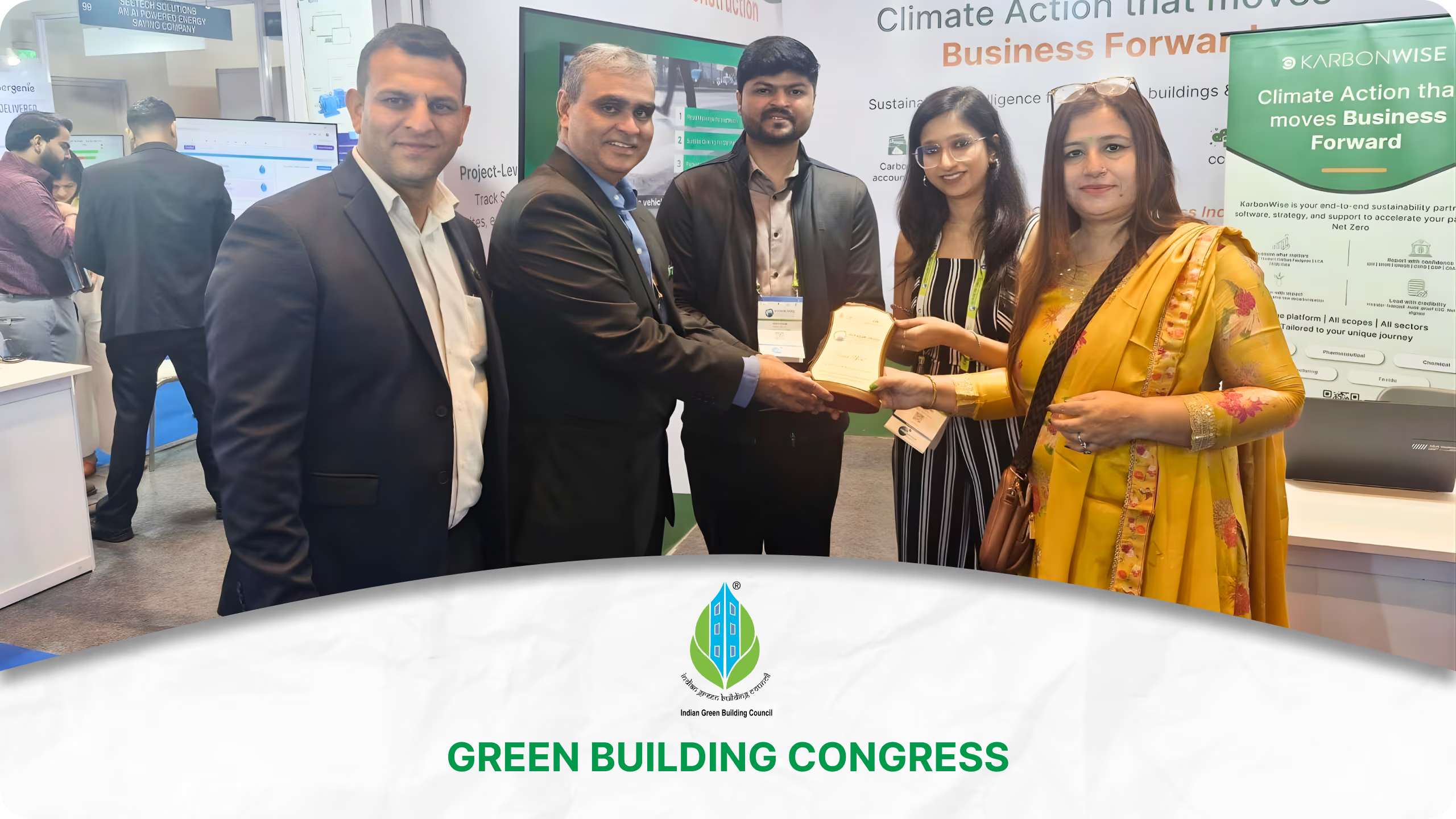
The 23rd edition of the IGBC Green Building Congress in Mumbai this year made one thing clear: India’s built-environment community is no longer exploring sustainability - it’s actively shaping how to implement it. With a registered green footprint now crossing 14.8 billion sq ft, IGBC continues to anchor one of the world’s largest and most rapidly evolving green-building ecosystems.
Walking through the expo floor, the momentum was unmistakable. The hall brought together material manufacturers, façade and coating companies, HVAC and mechanical systems firms, prefab innovators and sustainable building-tech providers. Companies like AURA Engineering Solutions, Sarda Metals & Alloys, BuildTrack, UltraTech Cement and Saint-Gobain were among the many showcasing new products, materials and technologies. It felt less like a traditional exhibition and more like a marketplace of ideas - each company contributing a piece of India’s sustainability puzzle.
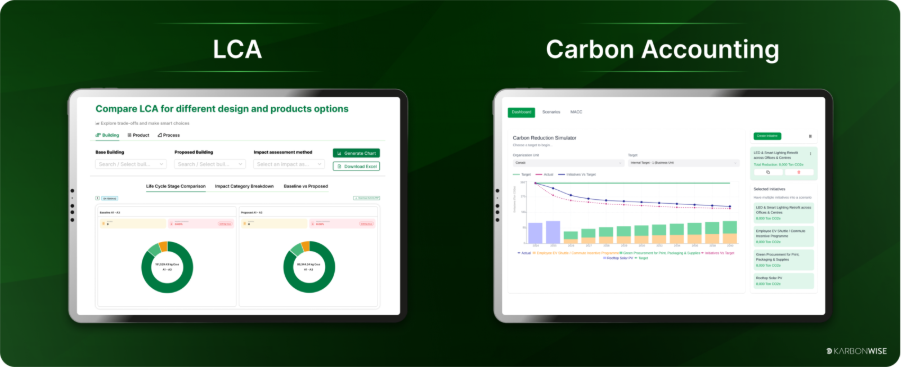
This year, IGBC also introduced a Product Launch Hub, a dedicated platform for exhibitors to unveil new offerings. Throughout the event, several companies used this stage to announce new materials, building systems and green innovations. In that environment, we introduced the newest version of our India-first platform, which connects building LCA, product LCA and carbon accounting into one workflow designed for Indian conditions.
Sustainability Conversations Felt Broader and More Practical
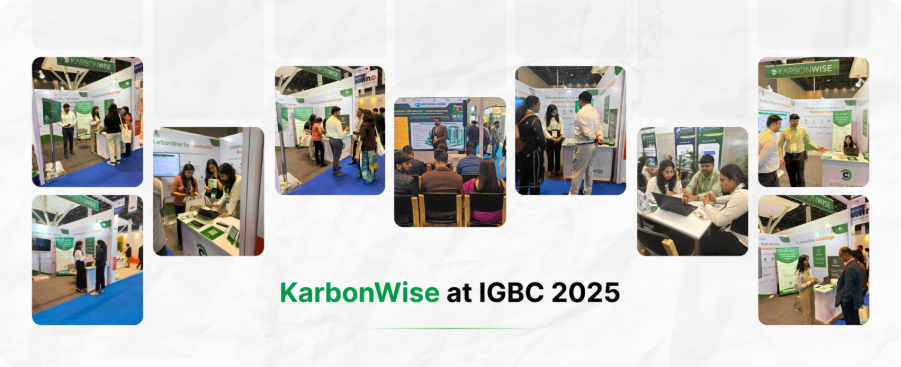
Across discussions with developers, architects, consultants, engineers and manufacturers, we noticed a marked shift in how sustainability is approached. People were not only talking about certifications or compliance; the focus had expanded to lifecycle performance, design-stage integration, resilience, future-readiness and the long-term value of sustainable choices.
Developers spoke about how early-stage design now needs to integrate sustainability considerations rather than treat them as add-ons. Consultants discussed the challenges of providing clear material insights quickly. Manufacturers shared their efforts to adopt cleaner processes and communicate improvements credibly.
Within this broader and more thoughtful dialogue, one theme kept resurfacing: the growing importance of materials and embodied impact. As India continues to build at massive scale, teams want to understand how material choices shape the environmental footprint of a building long before operations begin. This naturally led to LCA - not as a standalone topic, but as one of the most useful tools for making informed, India-relevant decisions.
KarbonWise Product Launch at IGBC
In the middle of this ecosystem of material, system and technology innovation, our product launch ended up becoming one of those moments where you could sense a shift on the congress floor. The Product Launch Hub was already buzzing with new materials and ideas, but when we introduced the latest version of our India-first LCA and carbon platform, it immediately felt like we were speaking to the exact challenges people had been raising all day.
What stood out was how quickly the audience connected to what we were showing. As we walked through India-specific LCA workflows, carbon accounting tuned to local supply chains, and a new early-stage comparison engine that works even before the BOQ exists, people weren’t just observing - they were leaning in. This wasn’t a feature update; it fit directly into the gaps the ecosystem has been wrestling with: global tools that don’t reflect Indian materials, assumptions or construction realities.
This made the launch feel less like a spotlight moment and more like a natural extension of the conversations happening across the event. With exhibitors showcasing greener materials and systems, the idea of evaluating these choices using India-relevant LCA data resonated instantly.
After the session, the booth saw a steady, engaged flow of visitors. Developers arrived to explore how early-stage modelling could influence schematic design. Consultants wanted to test IGBC-aligned documentation and scenario modelling. Manufacturers were the most vocal, seeing for the first time a practical pathway to produce India-ready LCAs and credible EPD-style outputs without wrestling with Western methodologies.
The enthusiasm was immediate, genuine and sustained. It affirmed what we have believed for a while: India is ready for a platform that understands how India truly builds - and this launch arrived at exactly the right moment.
The Challenges People Spoke About
Across conversations, several themes kept coming up, highlighting the practical gaps teams face today.
1. Global data doesn’t match Indian realities
Attendees consistently shared that global LCA and EPD tools rely on European or North American material datasets and energy assumptions, which leads to results that don’t reflect Indian construction practices or supply chains.
2. Support feels limited for India-specific use cases
Teams often struggle to get guidance on adapting global assumptions to Indian conditions, especially when dealing with IGBC submissions, local supplier data or Indian manufacturing processes.
3. Workflows don’t fit Indian procurement and construction
People pointed out that global tools expect structured, linear procurement, whereas Indian projects involve evolving specifications, multiple subcontractors and more variable material sourcing that existing workflows don’t accommodate.
4. EPD processes feel designed for Western manufacturing
Manufacturers shared that European-style EPD methodologies require upstream data and process transparency that many Indian suppliers don’t maintain, making it difficult to produce credible, India-relevant declarations.
5. Early-stage modelling is too slow with global tools
Developers and architects noted that most tools require detailed BOQs or completed design packages, meaning LCA arrives too late to influence concept-stage decisions where embodied carbon choices matter most.
6. Client expectations are rising faster than tool capabilities
Consultants described a growing demand for embodied-carbon comparisons, IGBC-aligned documentation and material insights, but said existing tools struggle to produce these outputs quickly or reliably for Indian conditions.
How Stakeholders Engaged With the Launch
{{flipcards}}
Why This IGBC Felt Significant
With multiple exhibitors showcasing new materials and building systems - and many using the Product Launch Hub to introduce innovations - the congress had a sense of forward movement. Our product launch felt less like a standalone announcement and more like an essential part of a larger shift toward better-informed, data-driven sustainability decisions.
The alignment between the ecosystem’s needs and our India-first direction was clear across conversations.
Final Reflection
IGBC 2025 showcased an industry moving steadily into deeper, more practical sustainability - rooted in materials, design, data and India’s real construction context. Introducing our updated LCA and carbon platform within this environment felt not only timely but also aligned with where the ecosystem is headed.
The conversations we had made one thing clear: India is ready for tools that reflect how India truly builds, and we’re excited to support that transition.
{{cta}}
{{accordion}}


Continue Reading
.avif)
Top 5 LCA Software Tools in 2026
Explore the top LCA software tools of 2026 and compare their features, strengths, and use cases for lifecycle assessment, carbon footprinting, and sustainability reporting.

LEED v5, Embodied Carbon, and the Whole-Lifecycle Mandate: What Project Developers and Asset Owners Need to Know
LEED v5 introduces a whole-life carbon approach to building certification, making embodied carbon assessment a key requirement for project developers, asset owners, designers, and investors.
.avif)


.avif)








.svg)
.svg)