Digital Product Passports: Turning Product Information into Circular Value
Digital Product Passports give products a digital identity across their lifecycle, supporting transparency, circularity and compliance through reliable, structured product data.


.svg)
Table of Contents


There is a moment most teams will recognise. You pick up a product and realise you know almost nothing about it beyond what the label tells you. Where were the materials sourced? How long will it last? What would it take to repair, reuse or recycle it properly? For years, these questions have lived in the background. Now, Digital Product Passports, or DPPs, bring them to the centre. They give products a digital identity that follows them throughout their life, offering transparency, traceability, and structured information that helps organisations move beyond one-way value chains.
DPPs are gaining momentum because they bridge the gap between sustainability intent and operational proof. They allow regulators to verify claims, manufacturers to improve design choices, service providers to repair more efficiently, and consumers to make informed decisions. They also introduce a new reality. Once product information becomes accessible, organisations must ensure it is accurate, consistent, and up to date. That shift is already reshaping how companies think about data, suppliers and product development.
Why DPPs Matter Today

The momentum behind DPPs is not theoretical. Market projections now suggest that the global Digital Product Passport market will grow from USD 185.9 million in 2024 to USD 1,780.5 million by 2030, reflecting an annual growth rate of 45.7 percent. This scale of increase highlights growing industry confidence in the operational and commercial value that DPPs can unlock: Digital Product Passport market projection.
At the same time, regulatory pressure is rising. European initiatives require products to carry verified digital information that supports circular economy objectives. This marks a clear shift from static product labels to dynamic, data-rich product records that evolve throughout the product’s life.
Organisations are also starting to understand that DPPs strengthen consumer trust. When repairability scores, material content, sourcing information, and care instructions are accessible, customers feel supported rather than overwhelmed by sustainability claims.
The Core Idea Behind DPPs
A Digital Product Passport is a structured, verified repository of information linked to a product, component or batch. It can store details on material composition, certifications, manufacturing processes, repair instructions, and end-of-life routes. Accessing it is simple, often through QR codes or serial identifiers that connect the physical product to a digital record.
This model offers businesses an opportunity to rethink how materials flow through their systems. It encourages closer supplier collaboration, data discipline, and product designs that favour durability and reuse. It also supports circular business models such as resale, refurbish-and-return, leasing, and component recovery, all of which benefit from reliable product-level information.
Recent European policy discussions emphasise that DPPs will be required across multiple product categories as early as 2024, linking compliance to the completeness and accuracy of digital product information.
What Makes DPPs Operationally Useful
DPPs are valuable because they connect fragmented data that traditionally sits in separate systems or remains undocumented. Manufacturers gain access to information that helps them design out waste. Retailers can support better customer experiences by offering verified care and repair guidance. Waste handlers can improve recovery rates by understanding materials more precisely.
The scale of potential adoption is striking, especially in sectors where traceability is already a priority. A recent projection indicates that more than 62.5 billion Digital Product Passports could be issued in the fashion sector alone by 2030, showing how quickly the model may expand.
These emerging insights suggest that DPPs will not remain pilot programmes for long. They are becoming infrastructure for future product systems.
Practical Components of a Strong DPP Programme
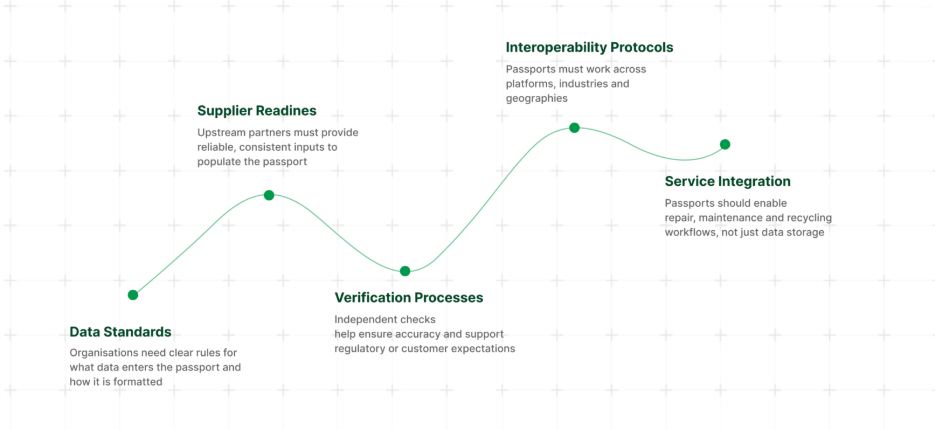
These components make DPPs more than a compliance requirement. They support continuous improvement and long-term product value.
Foundations That Determine Passport Success
{{blurb}}
Case Studies: DPP in Real Organisations
Consumer Electronics: Extending Lifecycles
Philips
Philips has been actively involved in EU-led Digital Product Passport and circular electronics initiatives, particularly around repairability and product transparency. Through enhanced digital product information and component-level data sharing, Philips has supported faster diagnostics and improved repair workflows in selected product categories.
Apparel: Strengthening Transparency
H&M Group
H&M Group has been one of the earliest apparel brands piloting digital product information systems aligned with upcoming EU DPP requirements. Its product transparency initiatives disclose fibre composition, sourcing details, and care guidance, supporting informed purchasing and improved post-sale use.
Furniture Manufacturing: Enabling Modular Design
IKEA
IKEA has publicly committed to Digital Product Passports as part of its circular transformation strategy. By linking product-level data to modular design and take-back programmes, IKEA is enabling easier refurbishment, reuse, and material recovery across selected furniture ranges.
DPPs and the Shift Toward Circular Economies
DPPs help organisations track where value is lost and where improvements are possible. They support reliable repair, encourage better sourcing decisions, and create product histories that travel with the item rather than getting lost during resale or disposal.
Textile-sector studies show both high interest and practical concerns. A survey of 81 stakeholders across 20 countries found support for standardised product information, but noted challenges around data quality, cost and privacy. This insight helps organisations understand where to focus capability building as adoption grows.
Together, these developments show a shift towards more transparent and accountable product systems.
Where KarbonWise Helps
KarbonWise helps organisations make Digital Product Passports operational by centralising material, supplier and product information in one consistent system. It supports structured data collection, helps link product details with wider reporting frameworks, and enables organisations to track product-level insights across design, sourcing and end-of-life planning. With a unified data environment, teams can move from fragmented records to reliable, decision-ready information that strengthens DPP implementation.
{{cta}}
{{accordion}}
{{sources}}
.avif)
.avif)
.avif)

Continue Reading

SBTi FLAG Guidance v1.2: What Changed and What to Do Next
Learn what's new in SBTi FLAG Guidance v1.2, including updated deadlines, mandatory commodities, no-deforestation requirements, and practical steps for businesses.

How to conduct a double materiality assessment: A practical step-by-step guide (2026)
Learn how to conduct a Double Materiality Assessment with this practical step-by-step guide covering impact and financial materiality, IROs, stakeholder engagement, scoring, materiality matrices, and ESG reporting.


.avif)









.svg)
.svg)