Innovations in Carbon Capture and Storage
Carbon Capture and Storage (CCS) removes and stores CO₂ emissions that cannot be eliminated through renewables alone. This article explores how CCS works, its role in hard-to-abate industries, and the latest innovations shaping its future.
.avif)

.svg)
Table of Contents


Introduction
Most climate strategies focus on reducing emissions, using renewable power, switching to electric transport, or making industries more efficient. These steps are essential, but they only tackle part of the problem. Even if we cut today’s emissions to zero, the carbon dioxide (CO₂) already in the atmosphere would continue to trap heat for centuries.
That’s why scientists and innovators argue that reducing emissions alone will not solve climate change. We also need solutions that actively remove carbon from the air and prevent new emissions from escaping. This is where Carbon Capture and Storage (CCS) steps in, offering a way to deal with the hard-to-abate emissions from heavy industries.
The Role of Carbon Capture and Storage
Imagine our atmosphere as a giant overflowing bathtub. For years, we’ve been running the taps wide open, burning fuels, building cities, and powering factories. The carbon dioxide pouring in has been rising dangerously high. Switching to clean energy is like turning the taps down, but even with that, the tub is already close to spilling over. This is where Carbon Capture and Storage (CCS) comes in. Think of it as a powerful drain system fitted to the tub. Instead of letting more water spill over, CCS captures the excess before it escapes, then channels it safely underground where it can’t cause harm. Sometimes, it even turns that captured carbon into useful materials.
Hard-to-abate Sectors and Why CCS is Vital
These are industries where emissions don’t just come from burning fuel, but also from the core chemical processes themselves. These are the sectors where CCS become a vital move.
.avif)
1. Cement – Cement alone is responsible for ~7% of global CO₂ emissions. CO₂ is released when limestone (calcium carbonate) is heated to make clinker, the key ingredient in cement. Even if you run the kilns on clean energy, that chemical reaction still produces emissions.
2. Steel and iron – Traditional steelmaking relies on coke (a coal product) to remove oxygen from iron ore. This process inherently releases CO₂.
3. Chemicals & fertilisers – Production of ammonia (for fertiliser) and other bulk chemicals often uses natural gas as feedstock, which creates unavoidable CO₂ emissions.
4. Refining and petrochemicals – Oil refineries, plastics, and other chemical plants emit large volumes of CO₂ during processing.
5. Waste-to-energy and biomass – Even though these can be renewable, burning waste or biomass still releases CO₂, which can be captured and stored.
Beyond Reduction: Tackling Legacy Emissions
Legacy emissions refer to the carbon dioxide (CO₂) that has already been released into the atmosphere over the past two centuries. Unlike current emissions, which we can try to cut with renewable energy or efficiency, these historic emissions remain in the air for hundreds of years, continuing to trap heat and drive global warming.
To address them, we need approaches that go beyond reduction and actively remove carbon from the air. This is where carbon capture frameworks (CCFs) come in. Technologies such as direct air capture, carbon mineralisation, and enhanced natural sinks are designed to draw CO₂ out of the atmosphere and either store it permanently or lock it into useful products.
By tackling legacy emissions through these CCFs, we move from simply slowing down future damage to actually repairing the climate system that has already been altered.
Types of Carbon Capture Frameworks
Not all carbon capture works the same way. Scientists and engineers have developed different approaches to deal with emissions, depending on whether they come from. Here are four of the most important methods:
.avif)
Post-Combustion Capture
This is the most common form, used in power stations and factories. CO₂ is captured from the flue gas after the fuel has been burned, usually with chemical solvents that absorb the carbon before it escapes into the air.
Pre-Combustion Capture
In this method, fuel such as coal, gas or biomass is converted into a mixture of hydrogen and CO₂ before it is burned. The CO₂ is separated out and stored, while the hydrogen can be used for energy.
Oxy-Fuel Combustion
Here, fuel is burned in pure oxygen instead of air. This produces flue gas that is mostly CO₂ and water vapour, making it easier to capture and store the carbon.
Direct Air Capture (DAC)
Rather than targeting emissions at the source, DAC pulls CO₂ straight out of the surrounding air. The gas can then be stored underground or used to make products like synthetic fuels and building materials.
Next-Generation Methods
The core capture methods are already in use, but researchers are pushing for the next wave of technologies that can make the process more affordable and less energy-intensive. A few stand out:
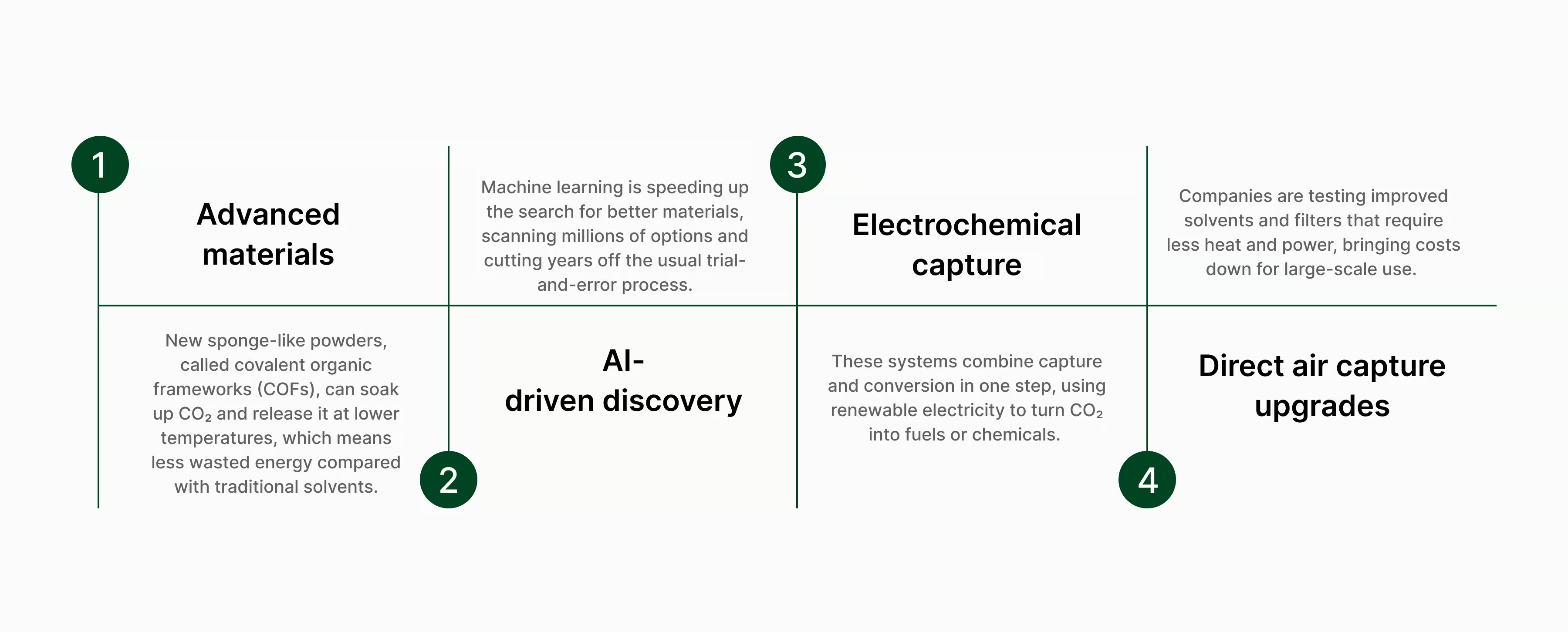
These innovations all aim to break the same barrier of high cost. If capture becomes cheaper and more flexible, it can be deployed on the scale needed for real climate impact.
Advancements in CCS
Capturing carbon is only the first half of the story. What really matters is what happens next, how that CO₂ is moved, stored and monitored for the long run. This is where recent advancements are helping to turn carbon capture from an experiment into a real climate solution.
Take storage, for instance. For years, depleted oil and gas reservoirs were seen as the go-to option. Today, scientists are looking beyond them to deep saline aquifers, which could safely hold much larger amounts of CO₂. With better imaging and monitoring, it’s now possible to check, almost in real time, that the carbon is staying put.
Transport is changing too. Pipelines will always be important, but purpose-built CO₂ ships are opening the door to international storage partnerships. Norway’s Northern Lights project is already proving how this could work in practice.
There’s also a digital revolution underway. From underground sensors to satellite systems, monitoring is becoming more accurate and transparent. That matters because public trust will ultimately decide whether CCS can scale.
Step by step, these advances are making carbon capture not just possible, but practical.
Case study: Norway’s Northern Lights project
Norway is often celebrated for its fjords, midnight sun and the northern lights that dance across its skies. Yet today, the country is also gaining attention for a different kind of light, a project that could guide the world towards a lower-carbon future.
The Northern Lights project, part of Norway’s wider Longship initiative, is one of the first large-scale efforts to capture, transport and permanently store carbon dioxide. CO₂ captured from industries is compressed, shipped by sea, and injected into rock formations more than two kilometres beneath the North Sea.
What sets Northern Lights apart is its open access design. Instead of being reserved for one company, the system is being built to serve industries across Europe, from cement factories to waste-to-energy plants. If it succeeds, it could provide the blueprint for how countries cooperate on carbon storage, turning a national project into a shared climate solution.
The Future of CCS
If the last decade was about proving that carbon capture works, the next will be about transforming how far and how fast it can go. Researchers and industries are already exploring developments that could change the game entirely.
One area of excitement is bio-based capture. Imagine using living organisms such as algae or engineered microbes to pull CO₂ directly from the air. These natural systems could one day complement industrial-scale plants.
The more we innovate, the more CCS shifts from being a backup plan to a central part of the climate solution. But let’s not forget that CCS is only a tool, one that must be used alongside rapid emissions reduction, not instead of it.
At KarbonWise, we help organisations navigate this evolving landscape and build credible, science-based climate strategies. Whether it’s reducing emissions, exploring offsets, or understanding tools like CCS, we guide you every step of the way.
{{cta}}
{{accordion}}
{{sources}}

Continue Reading

SBTi FLAG Guidance v1.2: What Changed and What to Do Next
Learn what's new in SBTi FLAG Guidance v1.2, including updated deadlines, mandatory commodities, no-deforestation requirements, and practical steps for businesses.
.png)



.avif)








.svg)
.svg)